Fresh Food Grows Up: Subscription Brands Become Acquirers, Retail Brands and Manufacturing Bets
Fresh and gently cooked dog food is leaving its novelty phase, as leading subscription brands buy other companies, win shelf space in thousands of stores, and compete on factories, fridges and formats that remove freezer friction.
By Good Company Editorial Desk
The Short Version
- Fresh is no longer a single direct to consumer trick. The segment produced a first acquisition by The Farmer's Dog, a reported sale of Ollie valued at over $600 million according to Reuters sources, and a second straight year above $1 billion in sales at Freshpet, the public retail incumbent.
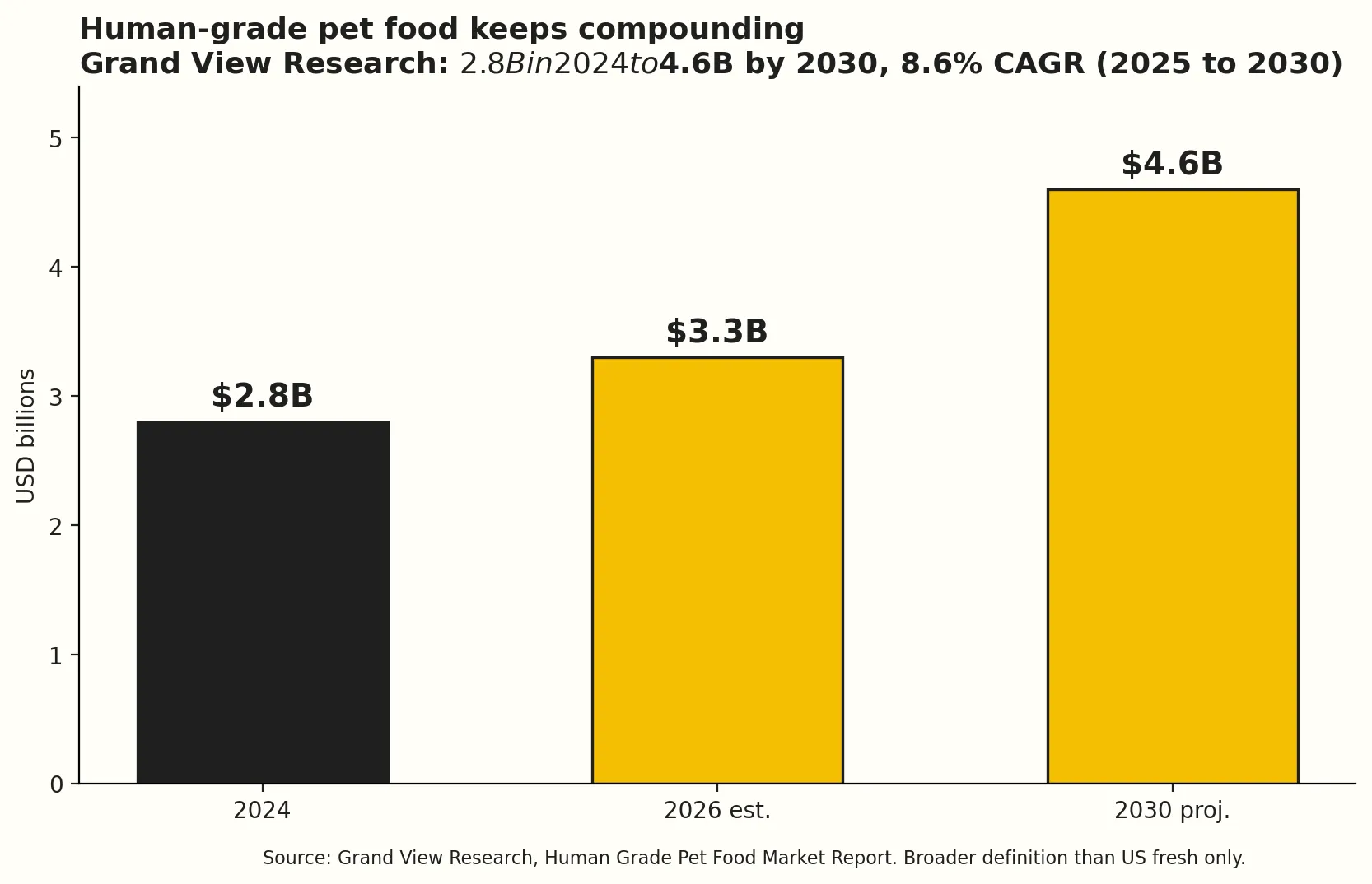
- The biggest number: Technavio expects the U.S. fresh pet food market to grow by $3.80 billion from 2025 to 2030 at a 21.3 percent compound annual growth rate. Grand View Research puts the broader global human grade market at $2.8 billion in 2024, rising to $4.6 billion by 2030.
- The biggest deal signal: buyers are paying for recurring subscription revenue, customer relationships and distribution they cannot build quickly, not just for recipes.
- The format race is about friction. Shelf stable gently cooked meals, scoopable frozen clusters that thaw in about 15 minutes, and shelf stable fresh dry products all keep the fresh promise without asking the owner to plan thawing a day ahead.
- The reader takeaway: the moat is moving. Recipes and branding opened the category. Manufacturing capacity, cold chain discipline, retail doors and fridges, and retention economics will decide who scales next.
The News
A subscription leader becomes a buyer
The clearest sign of maturity is that the best known subscription company is now an acquirer. The Farmer's Dog said it completed its acquisition of Woof on September 18, 2026, describing it as its first acquisition, according to its PR Newswire announcement. Woof, founded in 2019, makes functional enrichment and wellness products, best known for the Pupsicle refillable system. The company said Woof will keep operating independently under its own brand and team, while gaining access to The Farmer's Dog resources. Financial terms were not disclosed.
Woof ranked No. 3 overall on the 2025 Inc. 5000 and No. 1 in consumer products, according to Inc. BofA Securities was financial advisor and Latham & Watkins was legal counsel to The Farmer's Dog, according to the announcement. A first acquisition run with outside bankers, keeping the target independent, and adding a second daily habit, enrichment, next to the meal itself, looks like platform building, not a partnership of the early subscription era.
Nutrition is the foundation of a long, healthy life, but enrichment and play are also essential.
Jonathan Regev, co-founder and CEO of The Farmer's Dog, in a statement reported by Inc.
Ollie exits to a strategic owner
Spain based Agrolimen acquired Ollie, the New York fresh brand founded in 2016, in a deal announced in February 2026. PetfoodIndustry reported that terms were not disclosed, that Ollie will continue as an independent brand with its existing leadership and U.S. headquarters, and that no changes were planned to operations or the customer experience. Reuters, citing sources, reported a value of over $600 million. The parties did not confirm that value, so it is a reported figure, not a disclosed price.
Agrolimen already holds Nature's Variety in the United States and Affinity Petcare in Europe, according to Reuters. Ollie had been backed by Primary Venture Partners, Canaan Partners, Quadrille Capital, ECP Growth and Lerer Hippeau, according to PetfoodIndustry. A venture backed subscription brand, built on personalised fresh meals, a national cold chain and, in CEO Nick Stafford's comments on the deal, AI powered health screenings, became the U.S. fresh platform for a family owned international food group. That is an exit path the category could only promise a few years ago. Now it has a comparable.
Ollie was built on a simple but ambitious belief: that transforming what dogs eat can transform their lives.
Nick Stafford, CEO of Ollie, in comments reported by PetfoodIndustry.
Freshpet proves the retail version at scale
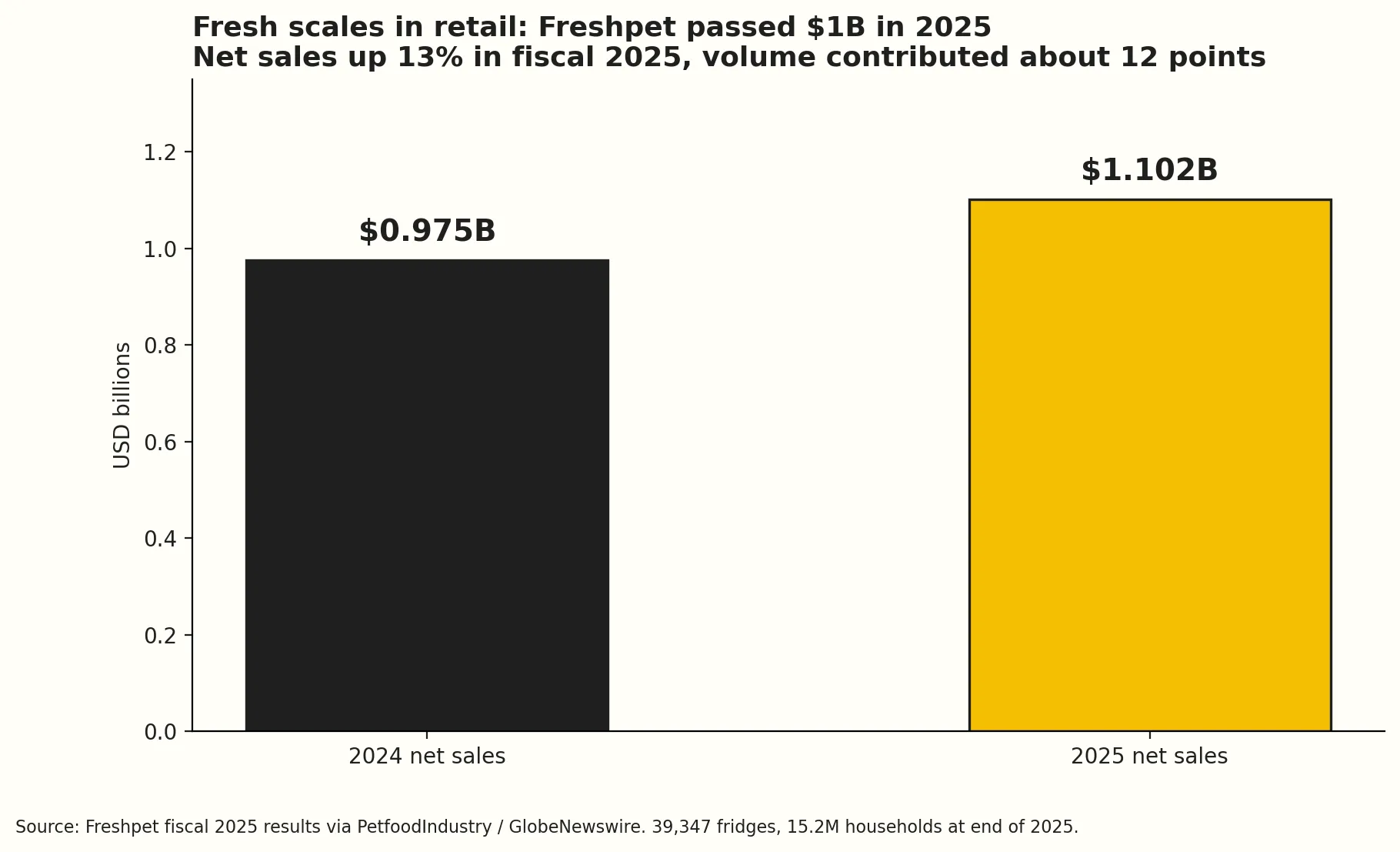
Freshpet reported fiscal 2025 net sales of $1.102 billion, up 13 percent year over year, with volume contributing about 12 points, and adjusted EBITDA of $195.7 million, according to its full year results in February 2026. It ended 2025 with 39,347 branded fridges and reached 15.2 million households, up 10 percent, and guided for 2026 to net sales growth of 7 to 10 percent and adjusted EBITDA of $205 million to $215 million.
Freshpet is retail first, built on placing its own refrigerated fixtures in stores. That is why its numbers matter to subscription brands: it proves fresh can pass $1 billion in annual sales without relying only on home delivery, and it shows the capital shape of the retail route, fridges, manufacturing lines and household penetration, store by store.
Stat callout: Freshpet reported $1.102 billion in fiscal 2025 net sales, up 13 percent, with 39,347 branded fridges at year end (Freshpet full year 2025 results).
Early stage money still enters, and the majors are already inside
DASH Dog Food announced on September 22, 2026 that it closed an oversubscribed $1.5 million seed round led by Voltage Ventures, with Western Technology Investment and individual investors participating, according to PetfoodIndustry. Founder Bobby Quirk was ButcherBox's first employee and later its vice president of operations. DASH separated from ButcherBox in June 2025, says revenue is up 130 percent since, dropped dry food after a June 2026 rebrand to focus only on fresh frozen cooked sous vide, and earmarked about 10 percent of the round for research and development including seafood and turkey recipes, according to PetfoodIndustry and founder comments to GlobalPETS. A $1.5 million seed next to a reported $600 million sale is not an embarrassment. It shows a working on ramp for a focused founder at the moment leaders consolidate.
Mars is on both sides of the next story. Mars Petcare agreed to acquire Nom Nom in January 2022, according to Just Food. Terms were not disclosed by Mars; a roughly $1 billion value was reported at the time and not confirmed. In August 2026 Nom Nom launched Scoopable Meal Clusters, a fresh frozen format that scoops from frozen and thaws in about 15 minutes, in chicken and sweet potato and beef and potato recipes for e commerce and specialty retail, according to PetfoodIndustry. The stated job is to remove defrost planning and open pack storage friction, the most practical reason owners abandon frozen fresh.
Mars Companion Fund was also among the investors in Happy Howl, alongside Michelson Found Animals, Darco Capital and Visible Ventures, according to PetfoodIndustry. Just Food dated the investment to April 17, 2025; the amount was not disclosed. Happy Howl makes gently cooked, shelf stable, human grade meals with no preservatives. Founder and CEO Colin Buckley said at the time that about 90 percent of sales were direct to consumer and 10 percent retail, with CVS and independent listings and a planned Chewy launch, according to Just Food. A major owning a frozen brand outright and holding a minority stake in a shelf stable brand is hedging format, not just buying growth.
Retail expansion becomes a system
JustFoodForDogs, founded in 2010, built open kitchens and a long Petco partnership. In March 2025 it introduced JustFresh, a shelf stable fresh line in resealable pouches, launching at six retail banners across 1,500 stores in April 2025, according to its PR Newswire announcement. That announcement cited Circana data showing fresh dog food dollar sales in measured retail rose 30 percent in 2024, against 2.4 percent for dog food overall. That is company cited scanner data in a launch release, not an independent audit, but its direction matches every other growth figure in this piece.
Open Farm announced in June 2026 that its portfolio, including freshly crafted meals alongside dry, wet, freeze dried raw, treats and supplements, would launch in nearly 1,700 PetSmart stores in the United States and Canada and online, taking total availability to more than 9,500 retail locations in North America, according to its BusinessWire announcement. A Pup Above says its gently cooked food is made sous vide in a USDA certified U.S. facility and is available in nearly 2,900 retail locations including Sprouts, Pet Supplies Plus, Hollywood Feed and Pet Food Express, according to its own site. Treat that count as company reported.
Cascadia Capital's Winter 2025/2026 overview, summarised by PetfoodIndustry, described digitally native brands moving into physical retail to lower customer finding costs and build trust, noting Ollie's selective Petco partnership from 2023, and naming The Farmer's Dog, Spot & Tango, Maev and Sundays for Dogs as brands to watch for a retail move. Its reported compromise is the operating compromise of this trend: many brands sell shelf stable versions in stores while keeping fresh subscriptions online.
Spot & Tango shows the marketing side of maturity. Founded in 2018 and known for UnKibble, its shelf stable fresh dry product, the company said in an October 2026 BusinessWire release that it has served more than 180 million meals and generates over $200 million in annual recurring revenue, as Goldman Sachs honoured founder and CEO Russell Breuer at its Builders and Innovators Summit. PetfoodIndustry earlier in 2026 reported over $100 million in ARR with 50 percent year over year growth, in coverage of its largest marketing campaign to date, with spend up 50 percent and $3.5 million for TV and out of home. The two ARR figures are from different dates and sources, so do not average them. Read together, they show a direct brand moving from performance marketing into broadcast scale.
What began as a way to give Jack better nutrition has grown into something far bigger than I ever imagined.
Russell Breuer, founder and CEO of Spot & Tango, in the company's October 2026 BusinessWire release.
Why It Matters
The definition fight is a strategy fight
Fresh means at least five operating models, each with a different cost:
- Refrigerated food from branded fridges in retail, the Freshpet model
- Fresh frozen portions by subscription, thawed at home, used by The Farmer's Dog, Ollie and DASH
- Gently cooked, shelf stable meals with no freezer, from Happy Howl and JustFoodForDogs' JustFresh
- Scoopable frozen clusters that thaw quickly, the new Nom Nom format
- Shelf stable fresh dry, Spot & Tango's UnKibble, plus baked retail lines that let subscription brands enter stores without a freezer
Refrigerated needs fixtures and tight date management. Frozen subscription needs insulated shipping and owners who plan ahead. Shelf stable gently cooked needs packaging and food safety that hold quality without preservatives, and must persuade owners that shelf stable can still mean fresh. Scoopable frozen needs manufacturing that freezes in small pieces and a bag that reseals well. Fresh dry must keep a fresh nutrition claim while behaving like kibble in a pantry. Format innovation in 2025 and 2026 is therefore not cosmetic. Each launch attacks the same objection, owners like fresh and dislike planning, storage and waste, from a different direction.
Human grade is the language, trust is the product
The Farmer's Dog says its meals are developed with board certified veterinary nutritionists, PhD nutritionists and veterinarians on staff and made to human grade safety standards, according to its company description. Ollie describes veterinary backed, personalised plans, according to PetfoodIndustry. JustFoodForDogs built its identity around science backed nutrition and kitchens where owners can see food prepared. DASH is pushing the language further with a standard it calls table grade, arguing in its launch materials that human grade alone does not distinguish sourcing or quality.
Read that race with scepticism and respect. Scepticism, because claims are claims until quality systems, digestibility work and recall history back them up. Respect, because the language does commercial work, explaining a large premium over kibble and giving a retail buyer a shelf story in one line. The next winners will be the brands whose operations make the claim boringly true, batch after batch.
Manufacturing and distribution become the moat
United Petfood, the Belgium based private label manufacturer, agreed to acquire Wellness Pet's dry plant in Decatur, Arkansas, for $24.22 million, according to Talk Business and Politics, which reported a 98,063 square foot plant on about 46 acres that Wellness bought in 2022 for $26.5 million. Pet Food Processing reported a long term supply agreement alongside the deal, and that Decatur becomes United Petfood's third North American site, with Mishawaka, Indiana and Drummondville, Quebec.
That was a dry plant, not a fresh factory, and should not be misread. Its relevance is structural: branded companies are rethinking which assets to own, manufacturers are consolidating plants, and supply agreements are securing capacity. Fresh faces the same question in a harder form, because gently cooked and frozen food needs specialised kitchens, freezing, cold storage and controls that ordinary kibble plants do not provide. A fresh brand without the right co manufacturer, or the capital to build, has a ceiling no marketing can lift. Freshpet's results, which described island fridge tests and a first line using a new technology the company believes can improve quality and profitability, point the same way, as the company's own account of its plans. Growth in fresh is now funded as infrastructure, not only as advertising.
Channels are converging too. JustFoodForDogs lists channels including its own kitchens, Petco, PetSmart, Chewy and Amazon on its how it works page. Nom Nom places a retail friendly format at PetSmart, according to launch coverage. Happy Howl was about 90 percent direct at investment and planned to strengthen retail. A retail buyer now asks whether a brand brings an online audience in store, can supply both an aisle and a freezer format, and will support the set with media. A subscription brand asks whether retail lowers acquisition cost enough to justify wholesale margin, and whether a shelf stable trial converts into a frozen subscription. Fresh is where that argument carries the most expensive logistics in pet food.
The Numbers
Two definitions, two useful answers
Technavio expects the U.S. fresh pet food market to grow by $3.80 billion from 2025 to 2030 at a 21.3 percent CAGR, according to its U.S. report. An earlier Technavio release put growth at $3.2 billion from 2025 to 2029 at 21.2 percent. Those are growth increments on a U.S. fresh definition, not a total market size.
Grand View Research measures broader and global. It valued global human grade pet food at $2.8 billion in 2024, estimates $3.3 billion in 2026, and projects $4.6 billion by 2030 at an 8.6 percent CAGR from 2025 to 2030, according to its report. Do not blend the two firms into one series. Technavio shows how fast the U.S. fresh opportunity expands on its definition. Grand View shows how a broader premium definition compounds globally.
Stat callout: Technavio forecasts U.S. fresh pet food growth of $3.80 billion from 2025 to 2030 at a 21.3 percent CAGR (Technavio).
Company scale, in reported figures
- Freshpet: $1.102 billion fiscal 2025 net sales, up 13 percent, adjusted EBITDA $195.7 million, 39,347 fridges, 15.2 million households (company results)
- Spot & Tango: over $200 million ARR and more than 180 million meals served (company BusinessWire release, October 2026); over $100 million ARR in earlier 2026 trade coverage
- Ollie: reported value over $600 million (Reuters sources); terms not disclosed by the parties
- Nom Nom: terms not disclosed by Mars in 2022; roughly $1 billion reported at the time, not confirmed
- DASH: $1.5 million seed, revenue up 130 percent since June 2025 separation (company via trade press)
- Happy Howl: amount not disclosed, April 2025, Mars Companion Fund among investors
- The Farmer's Dog and Woof: terms not disclosed
One public company above $1 billion, one private brand reporting over $200 million in recurring revenue, one brand reportedly sold for over $600 million, a global major holding a fresh brand bought four years ago, and a seed brand raising $1.5 million to compete with all of them: that spread defines a maturing market, with different capital needs and exit expectations at each level.
Distribution counts as a proxy for the moat
Door and fridge counts are not like for like, and the chart labels them by type. They are still the best public proxy for physical infrastructure built.
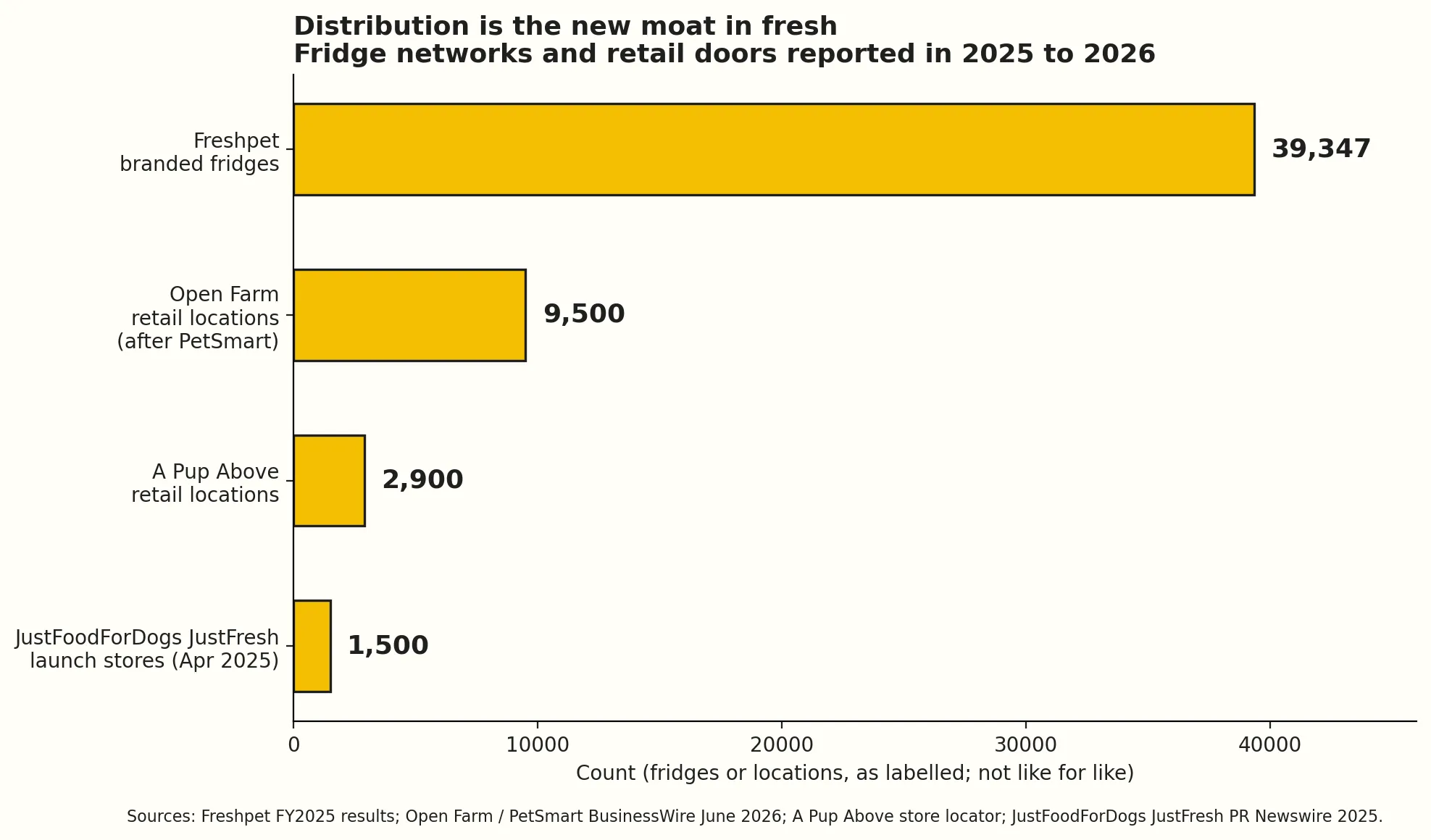
- Freshpet: 39,347 branded fridges at end of 2025 (company results)
- Open Farm: more than 9,500 retail locations in North America after PetSmart (company announcement)
- A Pup Above: nearly 2,900 retail locations (company)
- JustFoodForDogs JustFresh: six banners, 1,500 stores at launch in April 2025 (company announcement)
Every fridge is a capital and service commitment. Every thousand doors is a weekly supply, freshness and training problem. That weight is a moat when sell through holds, and a liability when it does not.
The deal tape needs the same honesty. Woof, Happy Howl and Nom Nom have no disclosed price. Ollie has a reported price only. DASH disclosed $1.5 million because seed rounds are announced to attract the next round. What the public record does show is who is setting direction: a subscription leader buying an enrichment company, a European family food group buying a U.S. subscription brand, Mars owning one fresh brand and investing in another, and venture firms still funding seed. Strategic and family capital, not only venture, now steers the category. That shift usually arrives when a category stops being an experiment and starts being a portfolio.
What It Means For You
If you run a fresh or gently cooked brand
Decide which friction you remove, in one sentence a tired owner understands at 6 p.m. Thaw planning, freezer space, portion waste, price shock and scepticism about claims are different frictions. Nom Nom chose thaw time. Happy Howl and JustFresh chose the freezer. Spot & Tango chose the pantry. DASH chose sourcing trust. That clarity is copyable even if the technology is not.
Audit capacity before the ad account. Write down weekly production ceiling, cold storage ceiling, co manufacturer backup, packaging supply and maximum ship days before quality suffers. Compare it with the demand a successful retail launch or TV test creates. If a win breaks operations, it becomes a churn and refund problem. In fresh, a stock out damages trust faster than in kibble, because the dog still needs dinner tonight.
Treat retail as a product brief, not a prize. A buyer giving you 1,500 doors is testing whether the product survives the shelf, explains itself without a founder video, and turns at a wholesale price. If the subscription pack cannot pass, build the retail product honestly, as Ollie did with baked recipes for Petco and JustFoodForDogs did with JustFresh, and keep the nutrition story consistent, or shoppers will assume retail is the lesser version.
If you run a premium brand outside fresh, or a retail store
Do not watch fresh from a safe distance. Its growth rates are well above total dog food growth on the figures cited here, and its leaders are buying companies and taking national shelf space. You will feel it first in fridge and freezer resets, in the veterinary and ingredient language owners expect from any premium pack, and in acquisition talks, where buyers compare your retention with subscription retention.
Borrow what transfers: portion clarity, visible ingredient standards, waste reducing feeding guidance, and a topper or mixer that lets owners add fresh without changing the whole diet. A Pup Above's own site notes owners can start with its food as a topper. A kibble or wet brand that makes partial adoption easy may keep customers who would otherwise switch entirely.
If you run retail, merchandise fresh as a system with an entry point: a shelf stable trial, a frozen or refrigerated commitment, then autoship or repeat in store. Shelf guidance on thawing and storage, and staff who can explain refrigerated, frozen, gently cooked shelf stable and fresh dry in plain language, are the conversion mechanism, not extras. Negotiate for data, not only margin, with shared sell through and trial to repeat reporting. Open Farm's PetSmart displays and Freshpet's island fridge tests are both attempts to learn with better visibility. And protect the cold chain as a trust asset: one warm fridge or expired short life pack undoes the premium claim for every fresh brand in the set.
If you are an investor or a corporate development lead
Underwrite operations, not brand heat. Ask for cohort retention by channel, contribution margin after shipping and packaging, spoilage and refund rates, production concentration, and cost to serve a retail door versus a subscriber. A slower brand with a second production source may be worth more than a faster brand with one kitchen and one carrier.
Respect the reported versus disclosed line. Build models from operating figures you can verify, Freshpet above $1 billion, Spot & Tango reporting over $200 million in recurring revenue, and treat reported deal values as comparable signals, not audited inputs.
What To Watch
Platform follow through
Watch whether The Farmer's Dog offers Woof to subscribers as part of a daily routine, whether Woof expands in retail with parent support, and whether the parent buys again in an adjacent habit. If Woof stays genuinely independent for a year, that discipline becomes a template for acquiring without smothering what was bought. One deal can be opportunistic. A second confirms a platform.
Watch Ollie inside Agrolimen: retail footprint, product cadence, leadership continuity, and whether Agrolimen uses Ollie as a U.S. fresh platform for further deals. Strategic ownership brings distribution and patience, and can also slow decisions. The reported value sets a high bar, and two years of visible execution will show whether it was a peak or a platform price.
Freshpet, formats and cats
Freshpet guided to 7 to 10 percent sales growth in 2026. Watch island fridge rollout, household growth after a 10 percent rise in 2025, and whether e commerce becomes material. It is the public scoreboard for retail fresh, and private brands feel its turns in buyer and investor conversations within a quarter.
Watch repeat, not launches, for clusters, JustFresh, shelf stable meals and UnKibble. Owners who start convenient may trade up to fuller fresh, or stay convenient forever. Both can work, at different margins. Brands reporting repeat and expansion, not only door counts, will tell you which.
Almost everything in this piece is about dogs, which reflects reporting, not a law. Technavio segments cat food inside U.S. fresh, and Smalls, named in Cascadia's overview as a brand that moved into hundreds of outlets, built its name in fresh cat food. Watch whether dog leaders extend credibly into cat, or cat specialists take that retail space first.
Price and capacity
Freshpet's 2025 growth came almost entirely from volume, with price and mix contributing about one point on its reported figures. That suggests growth from more households, not higher prices. Watch entry sizes, topper positioning and trial formats as the pressure valve. If fresh recruits owners at partial spend and expands them, growth can continue when full fresh feels expensive. If it insists on all or nothing, retail expansion will bring trial it cannot convert.
Finally, watch capacity deals. United Petfood's Decatur purchase will not be the last plant deal that matters, even though it was dry. Watch human grade and gently cooked capacity change hands, long term supply agreements replace plant purchases, and manufacturers market fresh and wet capability as a distinct U.S. offer. When capacity deals accelerate, brand demand has usually outrun the informal co packing that carried the early category. That is another, quieter definition of growing up.
Sources
- PR Newswire, The Farmer's Dog Completes Acquisition of Woof, Sept 18 2026.
- PetfoodIndustry, The Farmer's Dog completes acquisition of Woof.
- Inc., The Farmer's Dog buys Woof, Sept 2026.
- Reuters, Dog food maker Ollie acquired by Spain's Agrolimen, Feb 6 2026.
- PetfoodIndustry, Agrolimen acquires Ollie.
- PetfoodIndustry, Freshpet passed US$1 billion in annual sales in 2025.
- PetfoodIndustry, DASH Dog Food raises $1.5 million seed round.
- GlobalPETS, Round up: latest pet funding rounds.
- PetfoodIndustry, Happy Howl secures investment.
- Just Food, Mars backs Happy Howl, Apr 17 2025.
- PetfoodIndustry, Nom Nom launches scoopable fresh frozen dog food.
- BusinessWire, Spot & Tango Honored by Goldman Sachs, Oct 15 2026.
- Technavio, Fresh Pet Food Market in the US.
- Grand View Research, Human Grade Pet Food Market Report.
- PetfoodIndustry, Digitally native brands expand into physical retail (Cascadia summary).
- Talk Business and Politics, United Petfood buys plant for $24.22 million.
- Pet Food Processing, United Petfood expands North American footprint.
- JustFoodForDogs JustFresh announcement.
- Open Farm and PetSmart announcement.
- A Pup Above company site.
- JustFoodForDogs How It Works.