The New Store Equation: Pet Retailers Are Still Opening Stores, Just Not the Old Way
Pet retailers still want more stores, but 4.3 percent vacancy, rising rents and higher build costs have rewritten the math, and conversions, sale-leasebacks and shop-in-shops now beat the ground-up big box.
By Good Company Editorial Desk
The Short Version
- The trend: pet retail expansion has not stopped, it has changed shape. With US retail vacancy at 4.3 percent in the third quarter of 2026 according to Colliers, and construction and labor costs still rising, the winning growth moves are conversions of existing stores, sale-leaseback financing, smaller formats and shop-in-shop placements, not ground-up big boxes.
- The biggest number: Tractor Supply, the largest rural lifestyle retailer in the United States, plans to open about 100 new stores in 2026 after opening its 2,400th store in January, and its CEO says new stores are returning 23 to 25 percent on invested capital.
- The biggest deal signal: on November 19, Pet Supplies Plus announced it is converting nine former Petsense stores across six states, taking the franchise chain past 730 stores and, in its development chief's words, giving franchisees a way to grow quickly with an established location versus starting from the ground up.
- The squeeze underneath: CBRE reports US retail construction completions fell to a quarterly low of 5.5 million square feet in Q3 2026 while net absorption hit 9.6 million square feet, so demand for space is outrunning new supply.
- The reader takeaway: in 2027 planning, the question is no longer how many stores you can open, it is which growth format survives your cost stack: conversion, leaseback, franchise, small format or someone else's shelf.
The News
A conversion deal that explains the moment
The cleanest illustration of the new math arrived on November 19, 2026. Pet Supplies Plus, the Livonia, Michigan based franchise chain, announced it has added nine former Petsense stores across six states, in Abbeville, Louisiana; Chickasha, Oklahoma; Cleveland and Savannah and Jacksboro, Tennessee; Cornelia, Georgia; El Dorado, Arkansas; Emporia, Kansas; and Searcy, Arkansas. The company says it now operates more than 730 stores nationwide, and that it is looking at additional former Petsense locations, with plans expected to be solidified by year end.
Petsense is not a random seller. Tractor Supply acquired Petsense in 2016 to serve small and mid-size communities, and Tractor Supply spent 2026 reshaping that fleet: in its third quarter, reported in late October, the company opened 23 Tractor Supply stores and closed 74 Petsense stores, leaving 135. One chain's small-box experiment became another chain's expansion inventory. The nine converted stores stay open during remodeling, many Petsense employees are being rehired, and formal grand openings are tentatively planned for late February to March 2027. The converted stores will carry more than 11,000 products across 400 brands, plus a self-serve dog wash, a bakery and grooming at select locations, according to the company.
Securing these Petsense stores was a natural next step in our growth strategy. These nine locations allow us to further build on our network and bring our neighborhood pet store experience to new and underserved markets.
Nick Russo, Chief Development Officer, Pet Supplies Plus, in the company's November 19, 2026 announcement
Russo was explicit about why conversion beats construction right now:
This deal is a prime example of that mindset coming to life as we step closer to 750 units. It also serves as an avenue for franchisees looking to grow quickly with an established location versus starting from the ground-up.
Nick Russo, Chief Development Officer, Pet Supplies Plus, in the company's November 19, 2026 announcement
That is the new store equation in one quote. A converted store comes with a lease already negotiated, a trade area already proven by a pet retailer, staff who already know the customers, and a remodel bill instead of a ground-up build bill. Pet Supplies Plus is not an outlier riding one deal: in January the company reported it had signed more than 30 franchise agreements and opened 18 stores in 2025, seven of them in new markets, and said both it and sister brand Wag N' Wash were on track to open more than 20 stores a year in the coming years. Its 2026 Franchise Disclosure Document, as summarized from the filing, puts the estimated initial investment for a standard new store at $520,250 to $1,818,900 with an 8 to 18 month timeline to open. Against that range, a conversion with an existing box, existing customers and a February grand opening is not a compromise. It is the strategy.
The cost stack every operator now faces
The reason conversions are winning sits in a feature GlobalPETS published on November 17, 2026, which pulled together real estate executives, retailers and market data under a blunt headline: the new store equation. High construction costs, limited availability of suitable locations and tougher lease negotiations are prompting pet retailers to rethink how and where they grow, GlobalPETS reported.
Start with supply. Retail space in the United States is historically tight. James Cook, Director of Retail Research for the Americas at JLL, told GlobalPETS that US retail availability in the second quarter was down to 4.4 percent. Colliers put the US retail vacancy rate at 4.3 percent in the third quarter of 2026, with average asking rents of $26.20 per square foot, up 0.7 percent quarter over quarter, and net absorption of 10.5 million square feet, the highest quarterly total since 2023. CBRE's third quarter figures tell the same story from a second data set: average asking rents of $24.89 per square foot, up 2.5 percent year over year, and net absorption of 9.6 million square feet, the highest quarterly level since the fourth quarter of 2025. In its Q3 2026 US retail report, CBRE adds the number that explains the landlord's leverage: retail construction completions fell to a quarterly low of 5.5 million square feet, and the rolling four quarter total hit a record low of 7.4 million square feet, with rising construction costs and a labor shortage limiting deliveries.
CBRE counted 9.6 million square feet of US retail net absorption in Q3 2026 against just 5.5 million square feet of new completions, a record low rolling total for deliveries.
Then the costs. Cook told GlobalPETS that the cost of most things involved in a store is rising, naming energy prices, retail rents, labor, construction materials and goods, and CBRE added tariffs and labor shortages to the list. Data from the US Bureau of Labor Statistics, cited by GlobalPETS, puts the Producer Price Index for final construction up 3.5 percent year over year, and compensation costs for civilian workers up 0.9 percent in the second quarter compared with the first. None of these lines is dramatic alone. Stacked together, on top of a scarce site and a landlord who knows it, they change what a new store has to earn in its first years to clear a board's hurdle rate.
The lease itself has become a negotiation about who pays for growth. Ken Bleznak, Executive Vice President at CBRE, told GlobalPETS that lease talks increasingly turn on who pays for construction costs and on tenant improvement allowances, the pre-negotiated landlord contribution toward fitting out a space, and that tenants who previously did not request allowances now make them a deal point. Landlords, in turn, are pushing for higher return expectations, restrictive covenants against competition, and co-tenancy clauses that require a percentage of a project to be occupied. Every one of those clauses is a risk allocation, and in a 4.3 percent vacancy market the landlord holds more of the cards than at any point in recent memory.
Tractor Supply is the exception that proves the rule
One pet retailer is still building the old way, at scale, and it is worth studying exactly how it affords to. Tractor Supply opened its 2,400th store in Aiken, South Carolina in January 2026, one of about 100 new stores scheduled to open in 2026, after opening 99 Tractor Supply stores in fiscal 2025. Its third quarter showed the pet side of the business growing: net sales of $3.91 billion, up 5.1 percent, with the total pet business up 5 percent including new stores, Allivet and VIP Petcare, even as companion animal comparable sales were down about 2 percent, an improvement from down 4 percent in the first quarter.
CEO Hal Lawton told a recent conference, as reported by GlobalPETS, that the company's new locations are generating return on invested capital of between 23 and 25 percent, a level similar to what the company achieved 10 to 15 years ago.
Our new stores are profitable in the first year, cash flow positive in kind of somewhere between year 2 and year 3. This maturity curve benefit still significantly exceeds the impact of cannibalization as well as competitive impact.
Hal Lawton, CEO, Tractor Supply, as reported by GlobalPETS, November 17, 2026
The financing is the lesson. Tractor Supply builds standalone stores on land it controls, funds the roughly 18 month development cycle on its own balance sheet, pays the developer a flat fee, and then sells the finished building to a financial operator and leases it back, recovering the invested capital. Lawton says the arrangement saves about 10 percent on the cost of building stores compared with the conventional route. That is a sale-leaseback model, and it works because Tractor Supply is a large, investment grade chain developing standalone properties it can sell into a deep investor market.
That is a popular strategy with certain chains, but in the pet world, I can't think of anybody other than Tractor Supply that's really doing it.
James Cook, Director of Retail Research for the Americas, JLL, to GlobalPETS, November 17, 2026
Most large pet chains cannot copy it, Cook explained, because PetSmart, Pet Valu, Petco and Pet Supplies Plus do not build standalone boxes: they rent spaces in shopping centers and existing locations, chasing the foot traffic those sites already generate. So the industry's growth menu splits by balance sheet and format. If you own a repeatable standalone box and a strong credit rating, sale-leaseback can still fund a hundred stores a year. If you lease inside other people's centers, your growth levers are conversions, franchise capital, smaller footprints and rent negotiations. If you are a brand rather than a retailer, your growth lever is somebody else's store entirely, which is where the rest of this story goes.
Why It Matters
Growth did not stop, the financing changed
It would be easy to misread tight real estate as a no-growth story. The demand side says otherwise. The American Pet Products Association reported US pet industry expenditures of $158 billion in 2025, up 3.7 percent, and projects $165 billion in 2026, growth of about 4.4 percent, of which roughly two points are inflation. A market growing at that pace still rewards physical presence, because pet retail is one of the categories where the store does work that a website cannot: grooming, veterinary care, self-serve wash, adoption events, training, and the weekly food run that anchors a neighborhood trade area.
US pet spending reached $158 billion in 2025 and is projected at $165 billion in 2026, according to the American Pet Products Association.
What changed is who supplies the capital and who carries the construction risk. In the conversion model, the previous tenant's build-out is the subsidy. In the franchise model, the franchisee's capital is the engine: Pet Supplies Plus ended its 2025 fiscal year with 729 stores, 498 of them franchised, and its growth since has leaned on franchise agreements and conversions rather than company funded greenfield sites. In the sale-leaseback model, a real estate investor's capital funds the box and the retailer keeps the operating business. In the shop-in-shop model, the host retailer's capital built the store years ago, and the brand or clinic operator simply rents a department inside it. Four different balance sheets, one shared conclusion: the pet company that insists on funding every new store the old way, out of its own cash, on a greenfield site, at 2026 construction prices, is choosing the most expensive growth on the menu.
The K-shaped store map
Cook at JLL told GlobalPETS that both value retail and premium pet boutiques are among the winners in US expansion, reflecting the K-shaped pattern in consumer demand, with shoppers trading either up or down. The middle is where the equation bites hardest: a mid-priced, mid-sized box, in a mid-tier center, at a record asking rent, has to win against a discounter on one side and a service rich boutique on the other.
The store counts show how the ends are playing it. At the scale end:
- Tractor Supply: 2,400th store opened in January 2026, about 100 more scheduled for 2026, funded through its build and sale-leaseback pipeline
- PetSmart: more than 1,680 stores across the United States, Canada and Puerto Rico, per the company, with Banfield Pet Hospital clinics inside many of them
- Petco: more than 1,500 stores across the United States, Mexico and Puerto Rico, per the company, plus more than 250 Vetco Total Care hospitals
- Pet Valu: 882 stores in Canada after opening seven in the third quarter of 2026, with third quarter revenue of C$299.5 million, up 3.5 percent, and same-store sales back to growth at 1.5 percent
- Pet Supplies Plus: more than 730 stores, stepping closer to 750 units after the nine store Petsense conversion, growing through franchising
At the neighborhood end, the winners are smaller, service led and often converted rather than built. Pet Supplies Plus describes its model as the neighborhood pet store, and the converted Petsense sites fit it precisely: small to mid-size communities, an existing pet customer base, and services layered in at remodel, grooming, a self-serve dog wash and a bakery, that give the store revenue a website cannot take. Independent retailers are running the same play from the other direction. In the PETS+ Big Survey of more than 500 independent pet retailers and service providers in the United States and Canada, 47 percent of respondents said customer experience drives their sales most and 30 percent credited a knowledgeable sales team, while only 9 percent named competitive pricing. For an independent, the store is not a cost center to be minimized, it is the product, and a tight real estate market that blocks new big boxes is, quietly, a moat.
Services and shop-in-shops carry the box
The third response to the new equation is to make each square foot earn more, and to borrow square feet instead of building them. GlobalPETS notes the spread of shop-in-shop concepts, citing Banfield Pet Hospital locations within PetSmart stores as the pet industry's own long running example, alongside formats such as Sephora outlets inside Kohl's in general retail, urban small formats from European leader Fressnapf, and ZooRoyal growing inside grocery and do-it-yourself retailers in Germany. The logic travels: a clinic, salon or hospital inside a store raises the store's trip frequency and ticket, while the clinic operator gets a built store, an existing parking lot and a built-in customer flow for the price of rent on a department.
Brands are using the same borrowed-footprint logic at shelf level, and the last two weeks of pet news read like a tour of it. PetLabCo put four dog supplements into more than 1,500 US PetSmart stores in late October. The Pets Table took its shelf-stable fresh food into about 500 Whole Foods stores on November 16, its third major retail partner after Walmart and PetSmart. Nulo landed in all 179 Hollywood Feed stores in October on a specialty retail bet built around staff education. A Pup Above launched its first treats this week through independent retailers nationwide and its own site, a company that says it is already in more than 3,000 stores. None of these brands built a single store. All of them expanded their physical retail presence in the last 30 days. In a market where a new franchised store can cost up to $1.8 million before it opens, distribution through other operators' boxes is not the consolation prize. For most brands it is the only expansion line that pencils.
There is a European footnote worth one paragraph, because it shows the format innovation is global. GlobalPETS also spoke with Italy's Zoopark, which hunts highly visible, easy access sites with convenient parking, prefers to densify markets it already serves, and says a new store generally reaches stable sales in about six months, and with Ukraine's MasterZoo, which estimates about 12 months to mature sales, favors smaller formats for faster payback, opened nine locations in the first half of 2026, and now budgets backup power as a standard cost of opening after wartime attacks on energy infrastructure. The Ukrainian detail is extreme, but the underlying discipline is the same one US operators are learning: every assumption in the old pro forma, rent, build cost, time to maturity, even whether the lights stay on, now has to be re-earned market by market.
The Numbers
The real estate tape
- US retail availability: 4.4 percent in Q2 2026, according to JLL via GlobalPETS
- US retail vacancy: 4.3 percent in Q3 2026, according to Colliers via GlobalPETS
- Average asking rent: $26.20 per square foot in Q3 2026, up 0.7 percent quarter over quarter, according to Colliers; $24.89 per square foot, up 2.5 percent year over year, according to CBRE (the firms measure different universes, and both point the same way)
- Net absorption: 10.5 million square feet in Q3 2026, the highest quarterly total since 2023, according to Colliers; 9.6 million square feet, the highest since Q4 2025, according to CBRE
- New supply: retail construction completions of 5.5 million square feet in Q3 2026, a quarterly low, with a record low rolling four quarter total of 7.4 million square feet, according to CBRE
- Construction costs: Producer Price Index for final construction up 3.5 percent year over year, according to the US Bureau of Labor Statistics via GlobalPETS
- Labor costs: compensation costs for civilian workers up 0.9 percent in Q2 2026 versus Q1, according to the Bureau of Labor Statistics via GlobalPETS
- Retail investment: CBRE expects total US retail investment volume to rise 8 percent to $79.1 billion in 2026, with average loan to value down 60 basis points year over year to 58.2 percent in Q3
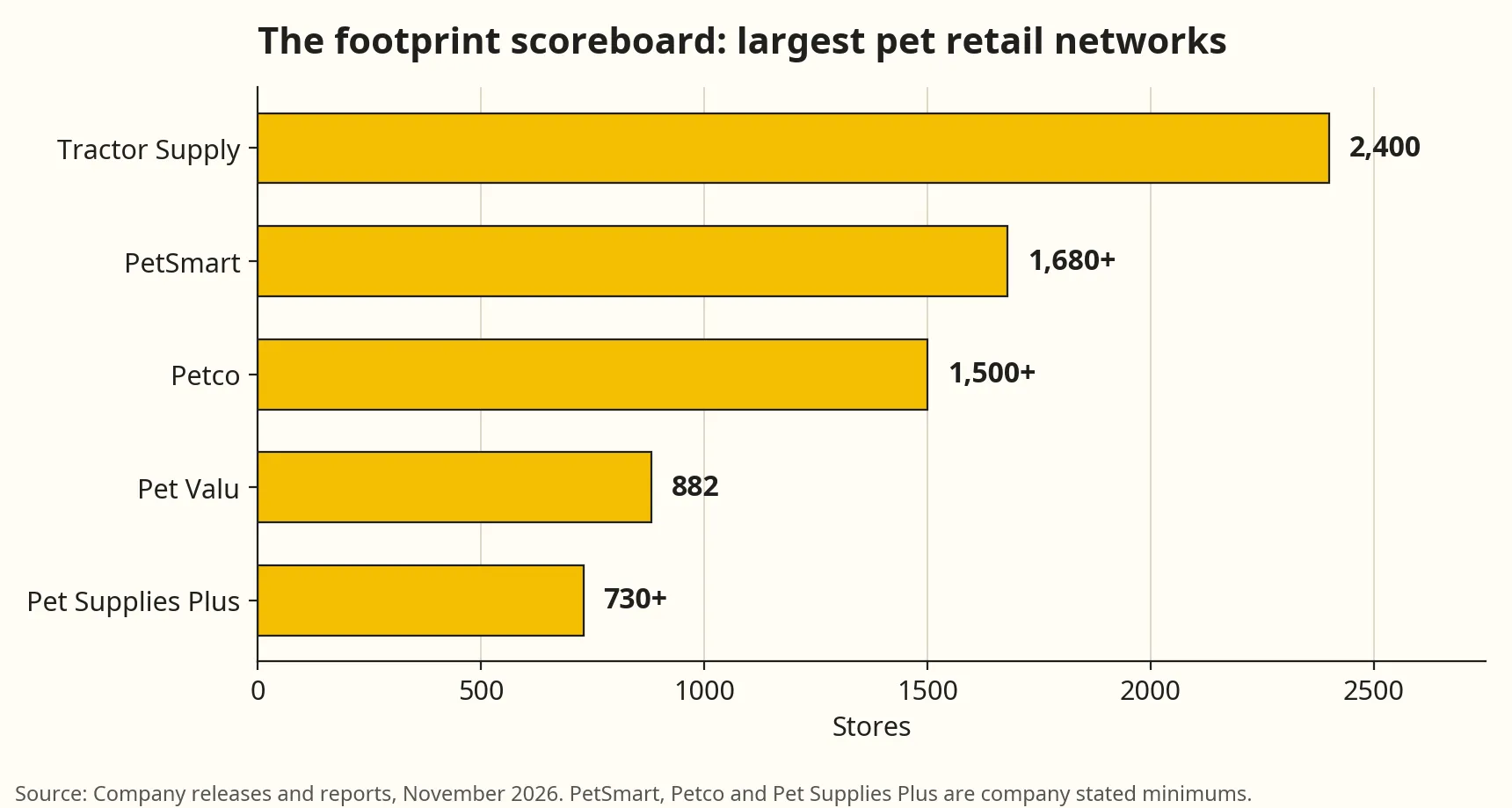
Figure 1: Store counts for the largest US and Canadian pet retail footprints. Sources: company releases and reports, November 2026.
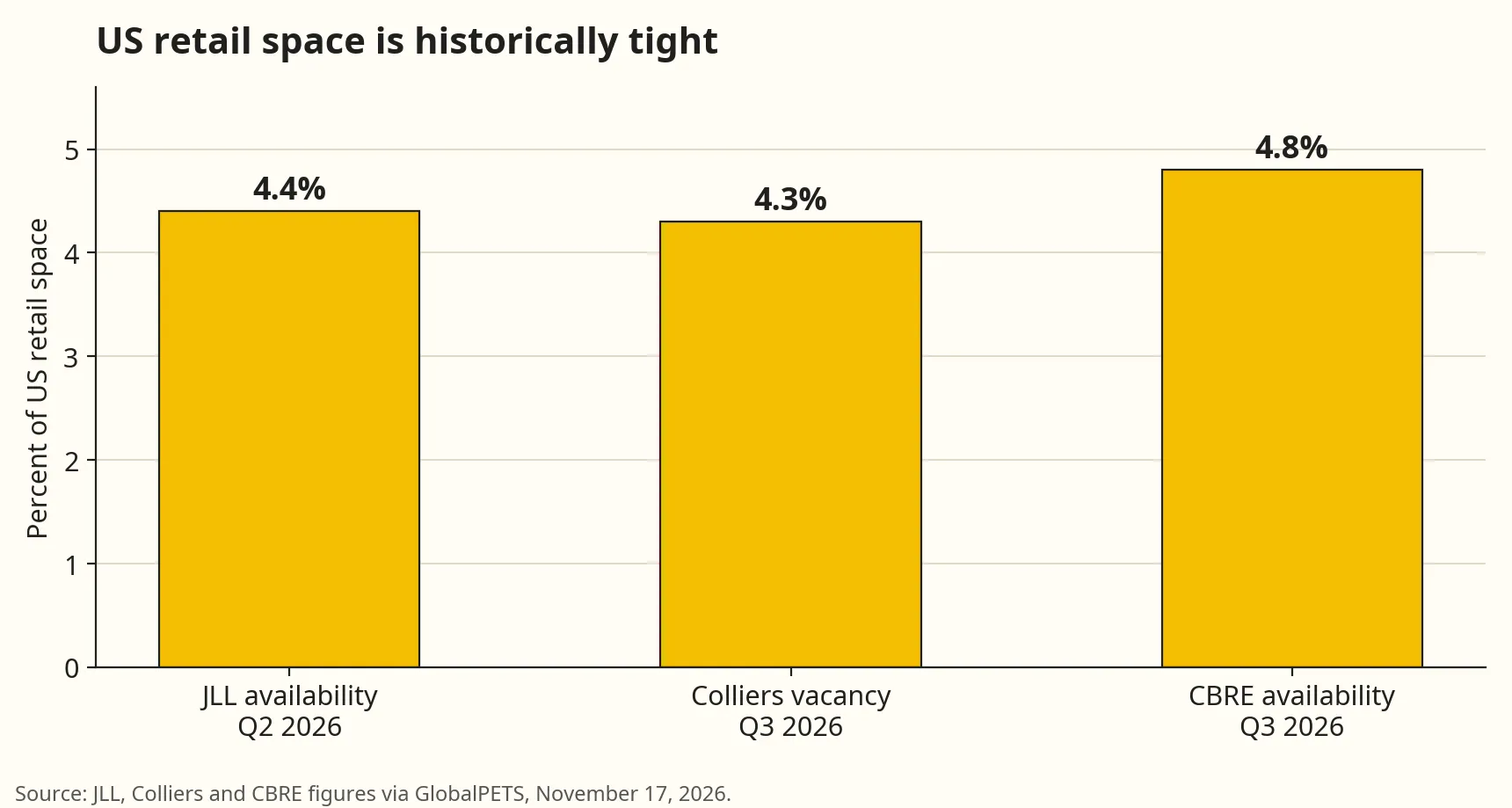
Figure 2: US retail space is historically tight by every firm's measure. Sources: JLL, Colliers and CBRE via GlobalPETS, November 2026.
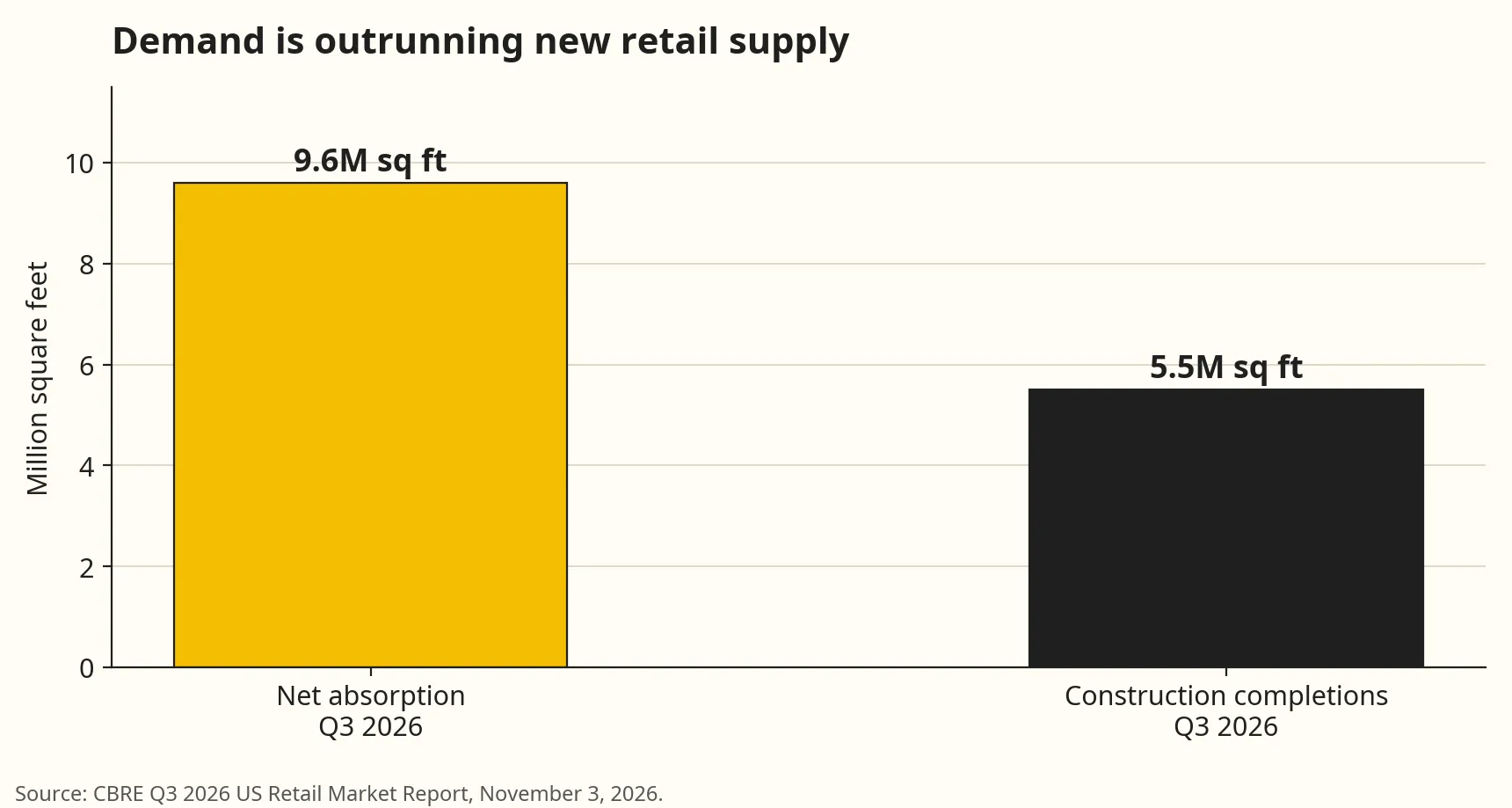
Figure 3: US retail net absorption versus construction completions, Q3 2026. Source: CBRE Q3 2026 US Retail Market Report.
The expansion scoreboard
- Tractor Supply new store returns: 23 to 25 percent return on invested capital on new locations, profitable in year one, cash flow positive between years two and three, according to CEO Hal Lawton via GlobalPETS
- Tractor Supply build savings: about 10 percent saved on store build costs through its flat fee development and sale-leaseback model, according to Lawton via GlobalPETS
- Tractor Supply pace: 99 stores opened in fiscal 2025, 2,400th store opened January 2026, about 100 scheduled for 2026, according to the company
- Tractor Supply pet quarter: Q3 2026 net sales of $3.91 billion, up 5.1 percent, total pet business up 5 percent, 23 stores opened and 74 Petsense stores closed in the quarter, leaving 135 Petsense stores
- Pet Supplies Plus conversion: nine former Petsense stores across six states, staying open during remodeling, grand openings tentatively late February to March 2027, according to the company
- Pet Supplies Plus scale: more than 730 stores after the conversion, stepping closer to 750 units; 729 stores at fiscal 2025 year end, 498 franchised and 231 company owned, per its Franchise Disclosure Document
- Pet Supplies Plus new store cost: estimated initial investment of $520,250 to $1,818,900 and 8 to 18 months to open for a standard franchised store, per the 2026 Franchise Disclosure Document
- Pet Supplies Plus momentum: more than 30 franchise agreements signed and 18 stores opened in 2025, seven in new markets, according to the company
- Pet Valu quarter: seven stores opened in Q3 2026 to reach 882, revenue of C$299.5 million up 3.5 percent, same-store sales up 1.5 percent
- Market context: US pet industry expenditures of $158 billion in 2025, projected $165 billion in 2026, according to the American Pet Products Association
Tractor Supply says the sale-leaseback route saves about 10 percent on the cost of building a store, and its new stores still return 23 to 25 percent on invested capital.
What It Means For You
If you run a chain or a franchise system
Your 2027 development plan should be a portfolio, not a pipeline. Rank every growth route by capital at risk per opened door: conversion of a proven pet site, franchised opening, small format in a dense existing market, shop-in-shop department, and only then the greenfield build. The Petsense conversion shows the cheapest doors in the industry right now are the ones a competitor already proved and no longer wants. Watch rival fleet reshaping the way you watch their pricing: Tractor Supply closed 74 Petsense stores in a single quarter, and the first nine went to the chain that was ready with franchisees, a remodel plan and a press release. Keep a standing conversion playbook, target list, remodel budget range and franchisee bench, so the next fleet shakeout is a phone call, not a scramble. And negotiate leases like the scarce asset they now are: tenant improvement allowances, co-tenancy protection and restrictive covenants are all live deal points in 2026, according to CBRE's Bleznak, and tenants who never used to ask for allowances now make them a condition.
If you run an independent store
The tight market is working for you more than against you. Vacancy at 4.3 percent means the big box that might have opened across the street is delayed, repriced or converted into a smaller bet, and the chains' own math now pushes them toward services, experience and neighborhood formats, which is the game you already play. Defend it with the assets a lease cannot replicate: the PETS+ survey says your customers come for experience and knowledgeable staff, not price. If your own lease renews in 2027, start the conversation now, while landlords are competing for creditworthy, service anchored tenants, and price the alternative honestly: moving a pet store means moving its grooming book, its adoption partnerships and its weekly food customers, and landlords know a pet tenant that survives is worth more than a vacant box at a higher asking rent. If you have ever considered a second location, the conversion route is open to you too: a closing or reshaping small-box pet site in a nearby town is the lowest capital second store you will ever be offered.
If you run a brand
Stop budgeting physical expansion as if stores were yours to open. Your realistic 2027 footprint growth is shelf space inside other operators' boxes: the 1,500 store supplement rollout, the 500 store grocery launch, the 179 store specialty chain placement and the 3,000 store independent network in this story were all won with sell-in, education and velocity, not leases. That changes what your team needs: retail readiness, staff training materials, and per-store velocity data now matter more than a flagship fantasy. It also changes your risk map. Your growth depends on hosts whose own expansion is slowing and reshaping, so diversify across host types, national chains, regional specialty, grocery and independents, the way The Pets Table stacked three different retail partners in eight months. When a host reshapes its fleet, as Tractor Supply just did with Petsense, your distribution can move with a signature. Know which of your doors sit inside fleets that are being reviewed.
If you lend, invest or own the real estate
Pet retail tenancy is repricing on quality, not quantity. CBRE's data shows capital still wants retail, with 2026 investment volume expected up 8 percent to $79.1 billion, but lenders are more conservative, with loan to value down to 58.2 percent. The sale-leaseback bid for standalone pet and rural lifestyle boxes rests on operator credit and store level returns like Tractor Supply's 23 to 25 percent, not on category romance. For franchised pet concepts, underwrite the conversion pipeline and the franchisee bench, not just the unit count: a system that can absorb nine proven stores in a quarter, keep them open through remodel and reopen them in 90 days is demonstrating a growth capability that a ground-up pipeline, at 8 to 18 months and up to $1.8 million a door, cannot match on speed. The diligence question for every pet retail growth story in 2027 is the same: show me the cost stack per door, and who else is paying it.
What To Watch
- Whether Pet Supplies Plus announces the additional former Petsense locations it says it is evaluating by year end, and how many of the nine conversions hit the late February to March 2027 grand opening window
- Tractor Supply's full year store count and whether it sustains the roughly 100 store pace in its 2027 plan, plus any further Petsense closures that feed the conversion market
- Whether any other large pet chain adopts sale-leaseback or build-to-suit financing at scale, which Cook at JLL currently sees as a Tractor Supply only strategy in pet
- Q4 2026 and Q1 2027 real estate prints: if vacancy stays near 4.3 percent and completions stay at record lows, landlord leverage and conversion premiums both rise
- Pet Valu's 2027 opening target after a seven store quarter, and whether Canadian chains lean harder on franchising as their capital light route
- How many 2027 brand launches choose borrowed footprints, grocery, specialty and shop-in-shop placements, over any owned retail at all
- Whether mid-market chains, caught between value and premium in the K-shaped map, start closing mid-sized boxes into the same conversion inventory the franchisors are buying
Sources
- GlobalPETS: New store equation, the changing economics of pet retail expansion (November 17, 2026), https://globalpetindustry.com/news/new-store-equation-the-changing-economics-of-pet-retail-expansion/
- Pet Supplies Plus: Expands into nine new markets with conversion of Petsense stores, via PETS+ (November 19, 2026), https://petsplusmag.com/pet-supplies-plus-expands-into-9-new-markets-converts-petsense-stores/
- Tractor Supply: Reaches major milestone with grand opening of 2,400th store (January 2026), https://corporate.tractorsupply.com/newsroom/news-releases/news-releases-details/2026/Tractor-Supply-Reaches-Major-Milestone-With-Grand-Opening-of-2400th-Store/default.aspx
- CBRE: Q3 2026 US Retail Market Report (November 3, 2026), https://www.cbre.com.sg/insights/figures/q3-2026-us-retail-market-report
- JLL: US Retail Market Dynamics, Q2 2026, https://www.jll.com/content/dam/jllcom/en/us/documents/reports/research-reports/26-insights-us-retail-q2-2026.pdf
- American Pet Products Association: US pet industry reaches $158 billion in 2025 (March 26, 2026), https://americanpetproducts.org/news/u.s.-pet-industry-reaches-158-billion-in-2025-poised-for-continued-growth-in-2026
- Pet Supplies Plus and Wag N' Wash 2025 growth release via PR Newswire (January 13, 2026), and the Pet Supplies Plus 2026 Franchise Disclosure Document as summarized by Franchise.com
- Tractor Supply Q3 2026 results and Pet Valu Q3 2026 results, as reported by the companies in October and November 2026 and covered by Good Company
- PETS+ Big Survey of independent pet retailers, as reported in 2026 Neighborhood Pet Store Day coverage