The Biology Bet: Pet Venture Money Moved Inside the Dog in 2026
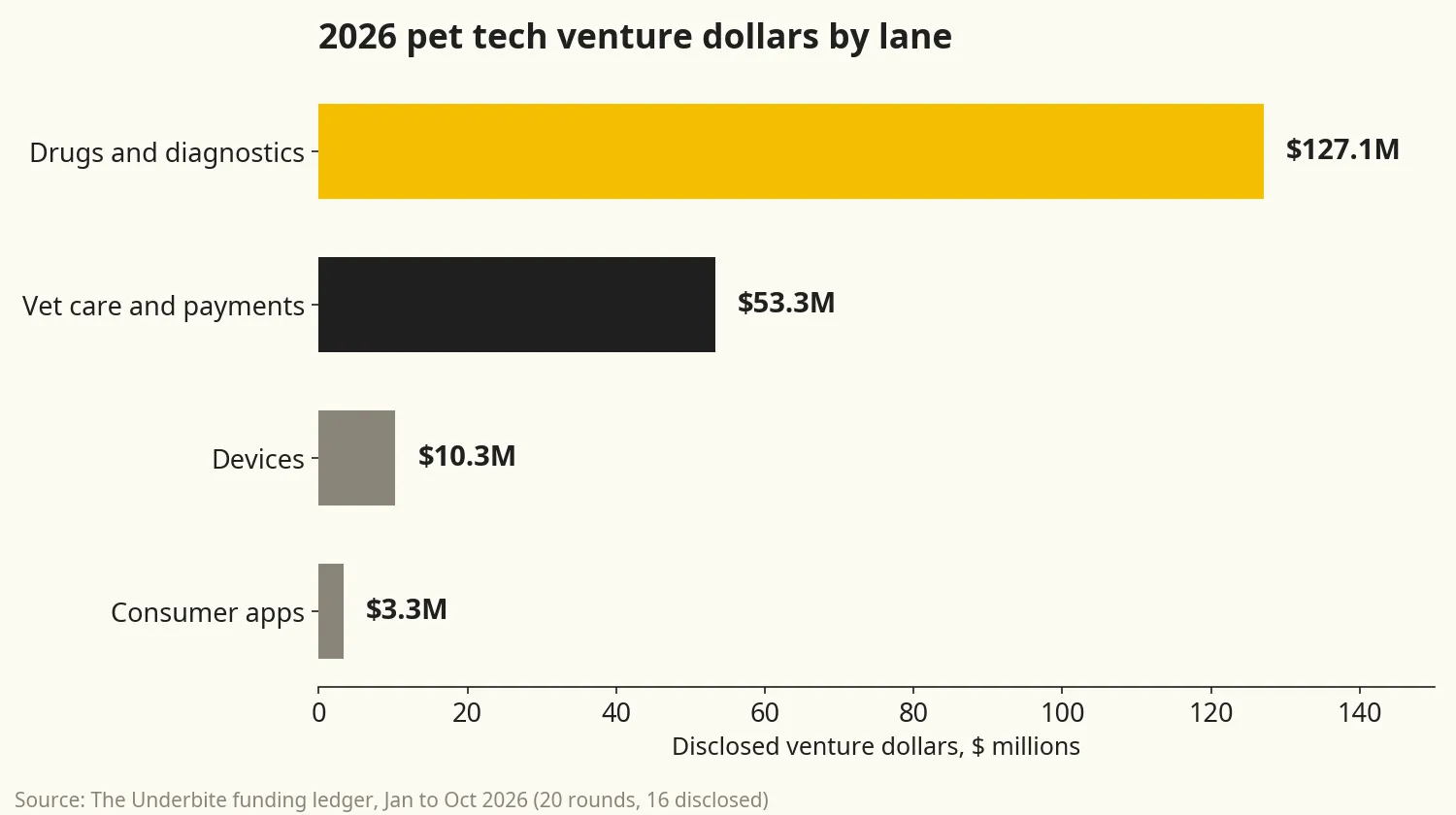
Of about $194 million in disclosed pet tech venture dollars through October, two thirds went to drugs and diagnostics, one company took half of it, and the collars and apps that defined the category five years ago split what was left.
By Good Company Editorial Desk
The Short Version
- The trend: venture money in pet tech and pet health stopped funding gadgets and started funding biology. In the 20 announced rounds The Underbite tracked from January through October 2026, drugs, biotech and diagnostics took 65.5 percent of disclosed dollars, while devices took 5.3 percent and standalone consumer apps took 1.7 percent.
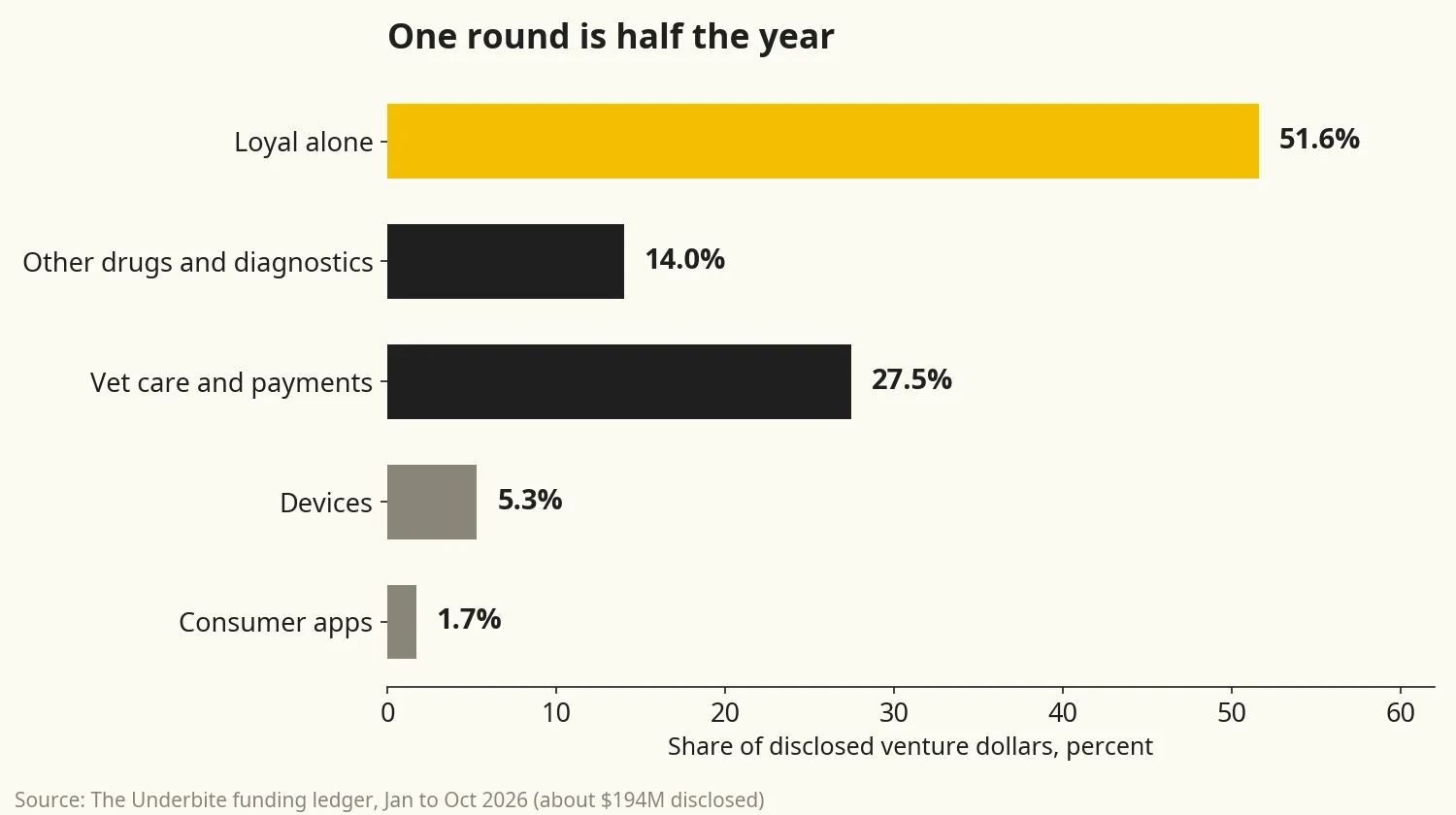
- The biggest number: about $194 million in disclosed venture funding across 16 rounds with a stated amount, and one round, Loyal's $100 million Series C in February, was 51.6 percent of all of it.
- The biggest deal outside the venture ledger: strategic buyers paid medicine prices for medicine assets. Zoetis agreed in March to buy Neogen's animal genomics business for $160 million, and Dechra agreed this month to acquire stem cell developer Gallant, terms confidential, as its lead therapy nears an FDA decision.
- The signal from the top of the market: on November 10, Mars said it will invest an estimated $1.4 billion in US manufacturing and operations in 2027, its largest single year commitment, including more than $34 million for four new BluePearl and Banfield pet hospitals. Corporate capital and venture capital are now pointed at the same place: care, tests and treatments.
- The reader takeaway: the defensible pet company of 2026 sells through the veterinarian, owns data or intellectual property a competitor cannot copy in a quarter, and prices like medicine. If your product is a device or an app with no clinical layer, investors have already told you what they think it is worth.
The News
A funding ledger that reads like a verdict
The cleanest snapshot of where pet venture money went this year comes from The Underbite, which logged every pet tech and pet health venture round it could confirm from a company announcement, its own coverage or trade press, from January 1 to October 31, 2026. The count is a floor, not a census, because many small rounds are never announced, and food brands, debt, grants and acquisitions are excluded. Twenty rounds were announced, sixteen disclosed an amount totaling about $194 million, and sorted into four lanes by what the company sells, the split is stark:
- Drugs and diagnostics: 7 rounds, $127.1 million disclosed, 65.5 percent of dollars
- Vet care and payments: 3 rounds, $53.3 million disclosed, 27.5 percent of dollars
- Devices: 7 rounds (4 disclosed), $10.3 million disclosed, 5.3 percent of dollars
- Consumer apps: 3 rounds (2 disclosed), $3.3 million disclosed, 1.7 percent of dollars
Devices matched drugs and diagnostics on deal count, seven rounds each. The difference is entirely in check size. The median disclosed round across the whole ledger was $3.75 million, and 9 of the 16 disclosed rounds were under $5 million. This was not a year of broad venture enthusiasm for pet. It was a year of one very large bet on a drug, a long tail of small bets on tests and delivery methods, and near silence everywhere else.
$127.1 million of about $194 million in disclosed pet tech venture dollars went to drugs and diagnostics in the first ten months of 2026, according to The Underbite's funding ledger.
One company is half the market
Loyal, the San Francisco clinical stage animal health company developing lifespan extending drugs for dogs, raised a $100 million Series C in February 2026, led by age1 with participation from Baillie Gifford and existing investors. The round took Loyal's total raised to more than $250 million since its founding in late 2019. It was, on its own, 51.6 percent of every disclosed pet tech venture dollar in the ledger. Without it, the year totals about $94 million.
The money is launch money. LOY-002, its daily pill for senior dogs, has cleared the effectiveness (RXE, February 2025) and target animal safety (TAS, January 2026) sections of the FDA conditional approval process, per Loyal's own reporting. As of late October 2026 the manufacturing section was still open, according to ConsumerAffairs reporting cited by The Underbite, so the drug is not on the market yet.
Our mission at Loyal is to help dogs live longer, healthier lives. We're closer than ever to achieving our goal: an FDA-approved drug to extend canine lifespan. This funding will support our team in completing the remaining FDA requirements and bringing our lead program to market.
Celine Halioua, Founder and CEO of Loyal, in the February 2026 Series C announcement.
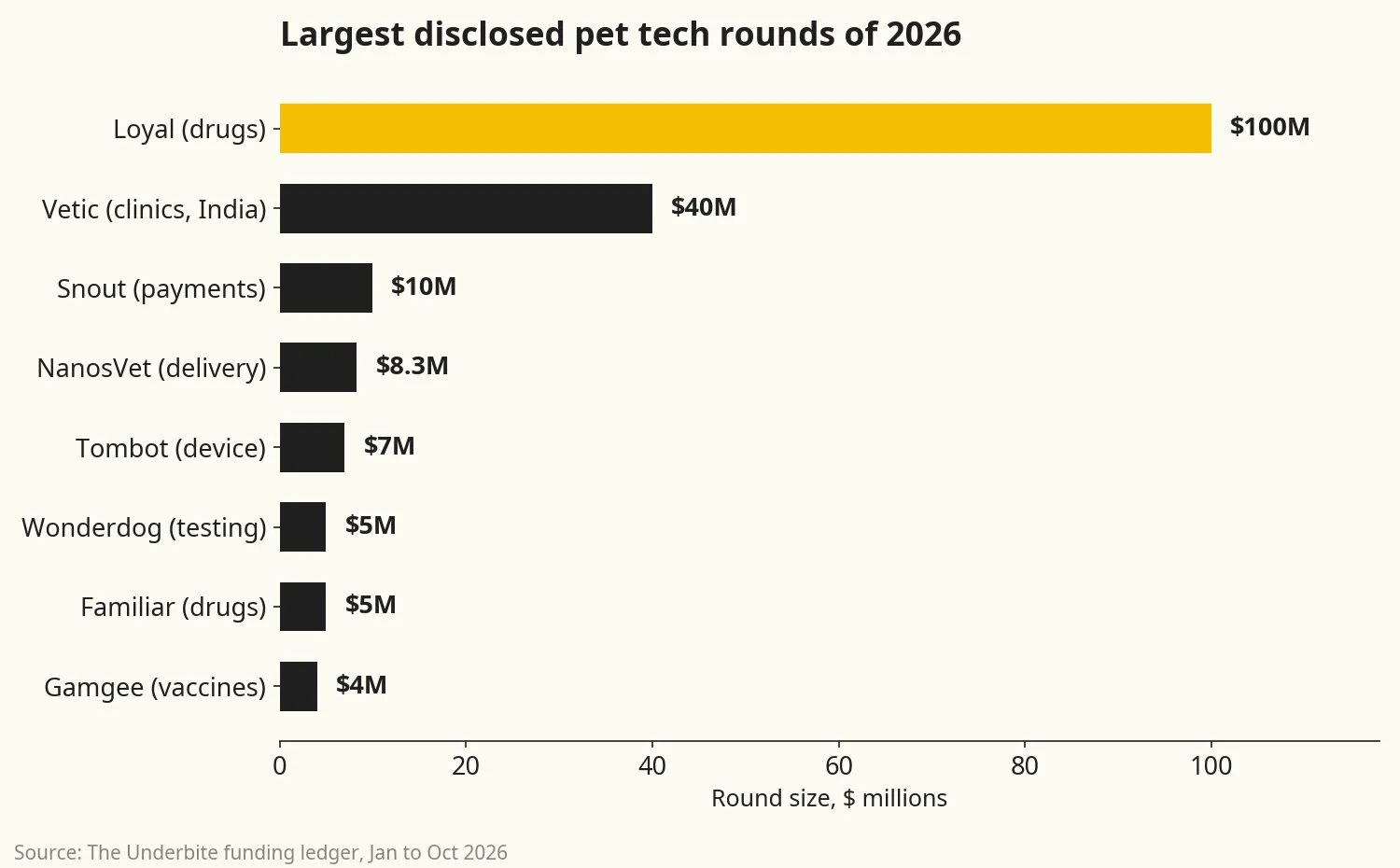
That is what venture capital is buying in this lane: not revenue, not users, but regulatory position. A company that completes an FDA process owns something a faster follower cannot clone. Nothing else in the category came close: nobody else in the ledger raised more than $40 million, and the second largest round was not even a US company.
The rest of the biology lane is small, busy and pointed at the clinic
Below Loyal, the drugs and diagnostics lane is a cluster of seed stage companies attacking specific clinical problems, each with a sourced fact pattern an operator can check:
- Gamgee (San Francisco, Y Combinator Summer 2026) raised a $4 million seed in August led by Founders Fund to build personalized mRNA cancer vaccines for dogs, sequencing each dog's tumor and matched healthy tissue to design a vaccine for that one dog. Its launch release is unusually honest about the evidence: the founding case, a dog named Rosie, entered remission and her cancer later returned, and the company is now running clinical studies in Australia with the University of New South Wales, the University of Queensland and the Garvan Institute to find out whether the approach works beyond one animal.
- Familiar Therapeutics (Redwood City, California) launched October 22, 2026 with a $5 million seed led by Pioneer Fund, Icehouse Ventures and BreakTHRU. Instead of discovering new molecules, Familiar licenses the veterinary rights to drugs with years of human research behind them. In five months it says it built 13 programs, opened two investigational new animal drug files with the FDA Center for Veterinary Medicine, and prepared a pilot study of its lead program, FAM-010 for canine hemangiosarcoma, at the University of Illinois. The gap it is selling into, per its launch release: the FDA approves more than 50 new human drugs a year, against fewer than 10 new companion animal drugs.
- NanosVet raised $8.3 million, recorded in a September Form D filing, for drug delivery strips, a reminder that in this lane even the delivery mechanism is fundable intellectual property.
- Wonderdog raised a $5 million pre-seed in July for at-home blood testing for dogs, and DeepScan Diagnostics raised $3.5 million in April for a cancer blood test for dogs. Elita raised about $1.3 million in October for at-home biological age and health testing. Three different companies, one shared bet: testing moves out of the reference lab and closer to the owner, with the veterinarian reading the result.
Our goal is to give vets proven, FDA-approved disease-modifying treatments for serious diseases in dogs and cats, where today they often have very few options.
Elizabeth Iorns, Co-Founder and CEO of Familiar Therapeutics, in an interview published by The Underbite in October 2026.
Devices got the meetings. Apps got almost nothing.
The device lane had the same number of rounds as the drug lane and about a twelfth of the money. The four disclosed device rounds totaled $10.3 million, three of them under $2 million: Hoomanely raised $1.8 million in August for connected feeders, PettiChat raised $1 million in March, and Moggie raised about $0.46 million in March for a cat wearable. Three more device rounds, from MOVA Pets (smart litter boxes), SATELLAI (wearables) and a Shenzhen medical device maker, did not disclose amounts at all. The one US device company with a substantial check, Tombot, raised $7 million in June, and The Underbite notes the check followed a 23,000 name waitlist for its robotic puppy for older adults: a dementia care story, not a pet health data story.
Consumer apps were thinner still: Petwealth raised $1.7 million in April and Travv raised $1.6 million in May, and with one undisclosed round the lane took $3.3 million, 1.7 percent of disclosed dollars. The apps that raised anything sit next to a transaction, a health plan or a booking, not a standalone subscription for content or tracking.
The round that was left out on purpose, and why it still matters
One October raise is excluded from the ledger totals, correctly, and it dwarfs everything in them. On October 22, 2026, Warhound came out of stealth with a $200 million seed round to clone and gene edit military working dogs, with Sequoia, In-Q-Tel and ARK Invest among its backers, using genetics licensed from Colossal Biosciences. Warhound does not sell to pet owners, so it does not belong in a pet tech count. But a single seed round for dog genetics, larger than all 16 disclosed pet tech rounds combined, shows where the largest investors think defensible value in animals sits: in the biology itself, sold to a buyer with a budget.
Warhound's single $200 million seed round was larger than all 16 disclosed pet tech and pet health venture rounds in 2026 combined (about $194 million), per The Underbite's ledger.
Why It Matters
Venture funds early. Strategics buy the same thesis later, for more.
The venture ledger is the early draft of an acquisition map. The companies writing the large strategic checks in 2026 bought the same categories the venture ledger rewards, at later stages and larger prices.
Zoetis, the world's largest animal health company, agreed on March 2, 2026 to acquire Neogen's animal genomics business for $160 million. That business generated about $90 million in sales in Neogen's fiscal 2025, serves customers in more than 120 countries from five laboratories, and feeds Zoetis's Precision Animal Health portfolio. The deal was expected to close in the second half of 2026. A public company paid roughly 1.8 times revenue for a testing network, in the same year venture investors gave testing startups their largest lane share in this ledger.
Dechra made the cell therapy version of the same move this month, agreeing to acquire San Diego based Gallant, whose lead product sonruvetcel, an off-the-shelf stem cell therapy for a painful feline mouth condition, has completed the effectiveness and 365 day safety technical sections of its FDA file. Terms were confidential. Dechra had already agreed in 2024 to buy Invetx for up to $520 million. The pattern is consistent: the large animal health companies are letting venture capital carry the early risk, then buying the survivors.
On the software side, IDEXX acquired Toronto based CoVet, an AI clinical workflow company, in September 2026 and folded it into a diagnostics business that grew third quarter revenue 10 percent to $1.214 billion, with diagnostics recurring revenue up 11 percent. The through line is the same: the test, the drug and the workflow inside the clinic are where margin and defensibility now live.
Mars is the exception that proves the structure
Mars operates at a scale where it does not need to choose between funding startups and building its own assets. It does both, and its November announcements show both hands moving at once.
Through Digitalis Ventures, which runs Mars Petcare's Companion Fund, Mars is the most active specialist investor in the early market. The Underbite tracked Digitalis leading or joining at least four announced pet rounds in 2026, including Travv, the plant based food brand Omni, the Hong Kong food subscription Buddy Bites and the grooming franchise Sparkle Grooming. Mars committed $300 million to its second Companion Fund in 2023. The main on-ramp is Leap Venture Studio, the accelerator backed by Mars Petcare and others, which invests $200,000 per startup, drew more than 300 applicants for its 2026 cohort, picked six, put two of the six in health, biotech or diagnostics, and is tilting its next cohort toward health, according to The Underbite.
At the corporate level, Mars announced on November 10, 2026 that it will invest an estimated $1.4 billion in its US manufacturing and operations footprint in 2027, the most it says it has invested in a single year, building on more than $9 billion invested across US operations since 2017. Inside that commitment, more than $34 million opens four Mars Veterinary Health hospitals early next year: three BluePearl hospitals in Ellicott City, Maryland and Austin and Katy, Texas, plus a Banfield hospital in Wilmington, North Carolina, creating up to 195 jobs. A separate $49 million investment in its Columbus, Ohio wet pet food plant brings Temptations Lickable Treats production to the US, with capacity for more than 400 million pouches a year. Mars says it operates more than 2,000 veterinary clinics and hospitals across the US.
As Mars marks 115 years in business, our commitment to American manufacturing has never been stronger. Ninety-four percent of the Mars products sold in the U.S. are made here, reflecting decades of investment in our people, operations and the communities in which we do business.
Claus Aagaard, CFO of Mars, Incorporated, in the November 10, 2026 investment announcement.
Read the two Mars moves together. The venture arm seeds diagnostics and biotech at $200,000 a ticket, and the parent builds hospitals and factories at $1.4 billion a year. The startups are not the strategy. They are the scouting system for a company that intends to own the clinic, the test menu and the shelf at the same time.
Why devices and apps lost the argument
The funding split is not a fashion cycle. It is investors pricing three hard facts.
First, hardware margins leak. A collar or a feeder carries component costs, returns, support and a replacement cycle, and the product can be matched by a Shenzhen factory in a season. The cautionary tale is already lived: Mars bought tracker maker Whistle in 2016, and the trackers were shut down in 2025 after the business moved to Tractive, as The Underbite notes. The device companies that still raise now pitch the data layer above the device: MOVA Pets describes its litter boxes and collars as entry points for an AI platform and says it is already profitable. The hardware is the doorway, not the house.
Second, a drug or a validated test is hard to copy and is priced like medicine. It sells through a professional channel that holds the customer relationship, instead of paying consumer acquisition costs to rent an owner from an app store.
Third, standalone apps have no toll booth: small monthly fees, no veterinarian in the middle, no proprietary asset underneath. The two app rounds that did close, Petwealth in health plans and Travv in travel booking, both sit beside a transaction. The lesson is not that software lost, clinic software is thriving. It is that software without a clinical or transactional anchor lost.
The clinic software exception, dated honestly
Any honest account of 2026 has to separate the year's rounds from the late 2025 rounds that set up the year's market, because the two are often conflated. Digitail, the Toronto based AI powered practice management platform, raised its $23 million Series B led by Five Elms Capital in November 2025, taking its total to more than $37 million, and says it serves more than 10,000 veterinarians and 3 million pet parents. London based Lupa raised a $20 million Series A led by Singular in October 2025, five months after its seed, taking its total to $25 million, to expand its AI agents and launch what it calls the world's first Veterinary AI Lab. Neither round is in the 2026 ledger, and neither should be counted in it. What they explain is 2026 itself: the practice management layer entered this year already capitalized, which is why the year's clinic software action ran through acquisitions, IDEXX buying CoVet among them, rather than new headline rounds.
The same discipline applies to US clinic networks. The Underbite found no announced equity round for a US clinic network in 2026. The two largest vet care rounds in its ledger went to clinic chains in India: Vetic raised $40 million in June, led by Bessemer Venture Partners, for a network it says runs more than 65 clinics in 11 cities with over 60,000 health plan members, and Dr Doodley raised $3.3 million in February. Together they took 81 percent of the vet care lane's dollars. US membership chains raised their large rounds in 2025, including Small Door's $55 million Series B, and in 2026 the US clinic story ran through strategic transactions, including Chewy's Modern Animal acquisition, valued by Capstone Partners at $400 million. US clinic equity did not disappear. It graduated from venture rounds to strategic transactions.
The one US vet care round in the ledger is therefore the most instructive one. Snout raised a $10 million Series A led by Footwork in January 2026, plus a $100 million debt facility from Clear Haven Capital Management that the ledger correctly excludes from its equity totals. Snout partners with clinics to sell prevention first wellness plans, typically including unlimited exams, vaccinations, bloodwork and flea and tick prevention, paid by owners in interest free monthly installments averaging about $65 a month, with no credit checks and no reimbursement paperwork, the company says. In the US in 2026, venture money did not buy clinics. It financed the customer's ability to pay the clinic.
The median disclosed pet tech round in 2026 was $3.75 million, and 9 of 16 disclosed rounds were under $5 million, according to The Underbite. Loyal alone raised more than the other 15 combined.
The Numbers
The 2026 ledger, in full
- Total announced pet tech and pet health venture rounds, January to October 2026: 20 (The Underbite)
- Rounds with a disclosed amount: 16, totaling about $194 million
- Drugs and diagnostics: 7 rounds, $127.1 million, 65.5 percent of disclosed dollars
- Vet care and payments: 3 rounds, $53.3 million, 27.5 percent of disclosed dollars
- Devices: 7 rounds (4 disclosed), $10.3 million, 5.3 percent of disclosed dollars
- Consumer apps: 3 rounds (2 disclosed), $3.3 million, 1.7 percent of disclosed dollars
- Largest round: Loyal, $100 million Series C, February, 51.6 percent of all disclosed dollars
- Year total without Loyal: about $94 million
- Median disclosed round: $3.75 million; 9 of 16 disclosed rounds were under $5 million
- Excluded from the totals on purpose: Warhound's $200 million seed (military working dogs, not a pet consumer business) and Snout's $100 million debt facility (debt, not equity)
The rounds behind the lanes, largest first
- Loyal: $100 million Series C, February. Lifespan drug for senior dogs. Led by age1, with Baillie Gifford. Total raised to date: more than $250 million.
- Vetic: $40 million, June. Clinic chain and home vet visits in India, more than 65 clinics in 11 cities and over 60,000 health plan members, per the company reporting cited in the ledger. Led by Bessemer Venture Partners.
- Snout: $10 million Series A, January, plus a $100 million debt facility. No interest wellness plans through partner clinics, averaging about $65 a month. Led by Footwork, debt from Clear Haven Capital Management.
- NanosVet: $8.3 million, September, per a Form D filing. Drug delivery strips.
- Tombot: $7 million Series A3, June. Robotic puppy for older adults, with a 23,000 name waitlist cited in the ledger.
- Wonderdog: $5 million pre-seed, July. At-home blood tests for dogs.
- Familiar Therapeutics: $5 million seed, October. Licenses human drugs for dogs and cats, 13 programs, two FDA drug development files open.
- Gamgee: $4 million seed, August. Personalized mRNA cancer vaccines for dogs. Led by Founders Fund.
- DeepScan Diagnostics: $3.5 million, April. Cancer blood test for dogs.
- Dr Doodley: $3.3 million pre-Series A, February. Animal hospitals in India.
- Hoomanely: $1.8 million seed, August. Connected feeders.
- Janus Labs AI: $1.8 million pre-seed, closed November 3, 2026 and therefore just outside the ledger's January to October window. Contactless Neuro AI that the company says measures brain activity in dogs and cats without touch, nine US patents, total raised $2.6 million. The claim is speculative and clinically unproven at scale, and the check size prices it that way.
- Petwealth: $1.7 million, April. Pet health app.
- Travv: $1.6 million seed, May. Pet travel booking.
- Elita: about $1.3 million, October. At-home biological age and health testing for dogs.
- PettiChat: $1 million seed, March. Smart pet device.
- Moggie: about $0.46 million seed, March. Cat activity wearable.
- Undisclosed amounts: MOVA Pets (Series A, smart litter boxes), SATELLAI (Series A, wearables), Shenzhen Vetoo Medical (devices) and Chongqing Qisuanfa (app).
The surrounding market the money is chasing
- The US pet industry reached $158 billion in 2025 and is projected to reach $165 billion in 2026, according to APPA figures reported by Capstone Partners.
- Pet care merger and acquisition activity rose 22.4 percent year over year to 60 announced or completed transactions, with sponsor activity up 56.3 percent, according to Capstone Partners' November 5, 2026 Pet Care Market Update. Add-on activity concentrated in Vet and Health (43.8 percent of add-ons) and Services (31.3 percent).
- Capstone's listed strategic benchmarks price the exit for the biology lane: Chewy's acquisition of Modern Animal at $400 million (3.2 times revenue) and SmartPak at $175 million (2.2 times sales).
- Pet insurance premiums in the US are projected to reach $6.4 billion in 2026, according to Reuters reporting cited in The Underbite's November 6, 2026 roundup, as rising vet bills push owners toward coverage and financing. That payer growth is the demand side of the Snout model.
- Mars, for scale: an estimated $1.4 billion of US investment planned for 2027, more than $9 billion since 2017, more than $34 million for four new veterinary hospitals, and more than 2,000 US veterinary clinics and hospitals already operating.
- Zoetis and Neogen, for the strategic price of testing: a $160 million price for a genomics business with about $90 million in fiscal 2025 sales, expected to close in the second half of 2026.
What It Means For You
If you are a founder
- Raise against a clinical milestone, not a user milestone. The checks in this ledger followed FDA sections completed, files opened and data a veterinarian can act on. If your next milestone is an app store ranking, expect a device lane check size: in 2026 the disclosed device rounds outside Tombot topped out at $1.8 million.
- Pick your lane honestly before you pitch. Investors have sorted this market into four boxes with wildly different check sizes. A device company pitching itself as a health platform will be diligenced as a device company. A testing company with a real validation plan is in the lane that took two thirds of the money.
- Use the specialist on-ramps. Leap Venture Studio took more than 300 applicants for six places in 2026 and is tilting its next cohort toward health. Digitalis Ventures, running the Mars Companion Fund money, was the most active specialist investor in the ledger. A $200,000 studio check is small, but it puts a startup inside the scouting system of the largest strategic buyer in the industry.
- Do not build a standalone consumer app and call it a company. The lane took 1.7 percent of the money. Attach to a transaction, a plan or a clinic workflow, or expect to bootstrap.
If you run clinics, a services business or a brand that sells through vets
- Your waiting room is about to become a sales channel for funded science. Loyal's launch preparation, Familiar's Illinois pilot, Gamgee's trial recruitment and the at-home tests from Wonderdog, DeepScan and Elita all need veterinary distribution or interpretation. Decide now what your standard is for hosting or recommending a therapy or test still completing its evidence base, because the asks will arrive practice by practice.
- Expect your software and payment stack to consolidate around you. Digitail and Lupa entered 2026 capitalized, IDEXX bought CoVet, and Snout finances the customer's side of your invoice. The independent point tool is an acquisition target, not a permanent vendor. Negotiate data portability and pricing protection while you still have alternatives.
- Watch your own add-on math. With deal volume up 22.4 percent and sponsors driving add-ons in Vet and Health and Services, per Capstone, a well run multi location services business sits in the two segments buyers are actively rolling up. Clean books and transferable systems are worth real money this cycle.
If you are a marketer or a retailer
- Health claims are about to be graded against diagnostics. When an owner's dog has a biological age score, a cancer blood test result and a vet reviewed plan, a bag that says it supports vitality in general terms will read as decoration. Brands selling wellness should build their claims architecture now, with substantiation that survives comparison to a test result.
- The shelf is not where this trend is won. Almost none of the funded companies in this piece sell through retail. They sell through clinics, subscriptions and plans. Retailers who want a share of the health dollar should be building the service and pharmacy adjacencies, screening, testing events, plan enrollment, that put them inside the care relationship instead of beside it.
- Steal the honest evidence playbook. Gamgee's launch told the market its founding case relapsed, and Familiar labels every program investigational. In a category where trust is the product, the companies disclosing their limits are building the brands that survive diligence.
What To Watch
- LOY-002's manufacturing section. The remaining FDA section decides whether the largest venture bet in pet history becomes a product in 2027 or a cautionary tale that reprices the whole lane.
- The Gallant decision. An FDA approval for sonruvetcel creates the first off-the-shelf stem cell therapy category in veterinary medicine and validates the buy the biology exit for every seed stage therapy company behind it.
- The Zoetis and Neogen close, expected in the second half of 2026. Watch GeneSeek's lab pricing and access once the largest animal health company owns testing rails its competitors also use.
- Familiar's first data. The FAM-010 pilot at the University of Illinois is the first test of the human drug repurposing thesis. Thirteen programs is a pipeline story; one program with dog data is a company.
- Gamgee's trial readouts in Australia. Personalized cancer vaccines live or die on whether the next hundred dogs look anything like the first one.
- Whether a US clinic network raises venture equity in 2027, after a year with none announced, or sells at another Capstone style multiple instead.
- The 2027 ledger itself: whether drugs and diagnostics hold a majority of dollars without one company supplying half of them.
Sources
- The Underbite, Pet Tech Funding 2026: Where the Money Actually Went, November 2, 2026. https://www.theunderbite.co/technology/pet-tech-landscape
- The Underbite, Familiar raises $5M to take human drugs to pets, October 22, 2026. https://www.theunderbite.co/news/familiar-therapeutics-5m-seed-human-drugs-dogs-cats
- Business Wire via FinancialContent, Familiar Therapeutics Launches with $5 Million Seed to Close the Gap Between Human and Veterinary Medicine, October 22, 2026. https://www.financialcontent.com/article/bizwire-2026-10-22-familiar-therapeutics-launches-with-5-million-seed-to-close-the-gap-between-human-and-veterinary-medicine
- GlobeNewswire, One Dog's Legacy Becomes GAMGEE, August 17, 2026. https://www.globenewswire.com/news-release/2026/08/17/3346437/0/en/One-Dog-s-Legacy-Becomes-GAMGEE.html?f=22&fvtc=5&fvtv=32375057
- Medical Daily, Rosie's Cancer Came Back After Her AI-Designed Vaccine, and Her Owner Just Raised $4 Million, August 2026. https://www.medicaldaily.com/rosie-dog-ai-mrna-cancer-vaccine-gamgee-launch-477500
- StartupRise, Loyal Raises $100M in Series C Funding, February 12, 2026 (carrying Loyal's announcement and the Halioua quote). https://startuprise.io/loyal-raises-100m-in-series-c-funding/
- Mars, Incorporated, Mars Will Invest $1.4 Billion in U.S. Manufacturing and Operations in 2027, November 10, 2026. https://www.mars.com:443/news-and-stories/press-releases-statements/mars-investment-us-manufacturing-operations-2027
- Grainews, Zoetis to acquire Neogen Corp. genomics business, March 2026. https://www.grainews.ca/daily/zoetis-to-acquire-neogen-corp-genomics-business/
- The Animal Economics, Zoetis expands precision animal health push with Neogen genomics deal, March 2026. https://www.theanimaleconomics.com/zoetis-expands-precision-animal-health-push-with-neogen-genomics-deal.html
- PetAge, Snout Secures Over $110M in Capital to Make Preventive Pet Care Accessible for Every Pet, January 29, 2026. https://www.petage.com/snout-secures-over-110m-in-capital-to-make-preventive-pet-care-accessible-for-every-pet/
- Pulse2, Snout: Over $110 Million Raised To Expand Prevention First Pet Care Financing Nationwide, January 28, 2026. https://pulse2.com/snout-over-110-million-funding/
- Digitail, Digitail Raises $23M Series B Led by Five Elms Capital, November 10, 2025. https://digitail.com/blog/digitail-raises-23m-series-b-led-by-five-elms-capital/
- Goodwin, Goodwin Guides Lupa in Raising $20M at Series A, October 2025. https://www.goodwinlaw.com/en/news-and-events/news/2025/10/announcements-technology-goodwin-guides-lupa-in-raising-20-million-at-series-a
- Dealroom News, Janus Labs raises $1.8M pre-seed for contactless neural AI reading pets' brains, November 3, 2026. https://dealroom.co/news/169182-janus-labs-raises-1-8m-pre-seed-for-contactless-neural-ai-reading-pets-b/
- Capstone Partners, Pet Care Market Update, November 5, 2026. https://www.capstonepartners.com/insights/report-pet-care-market-update/
- The Underbite weekly roundup, Zoetis Q3, Pet Resort Acquisition and Rover Shakeup, November 6, 2026 (pet insurance premium projection attributed to Reuters). https://newsletter.theunderbite.co/p/zoetis-q3-pet-resort-acquisition-rover-shakeup