The Cat Economy: Cats Are Outgrowing Dogs, and the Industry Is Rebuilding Around Them
Cat food sales grew more than three times as fast as dog food in September, cat ownership reached 53 million U.S. households, and the brands winning the shelf are the ones built for picky, multi-cat, younger owners who treat toppers, lickables and wet food as the daily routine, not the treat.
By Good Company Editorial Desk
The Short Version
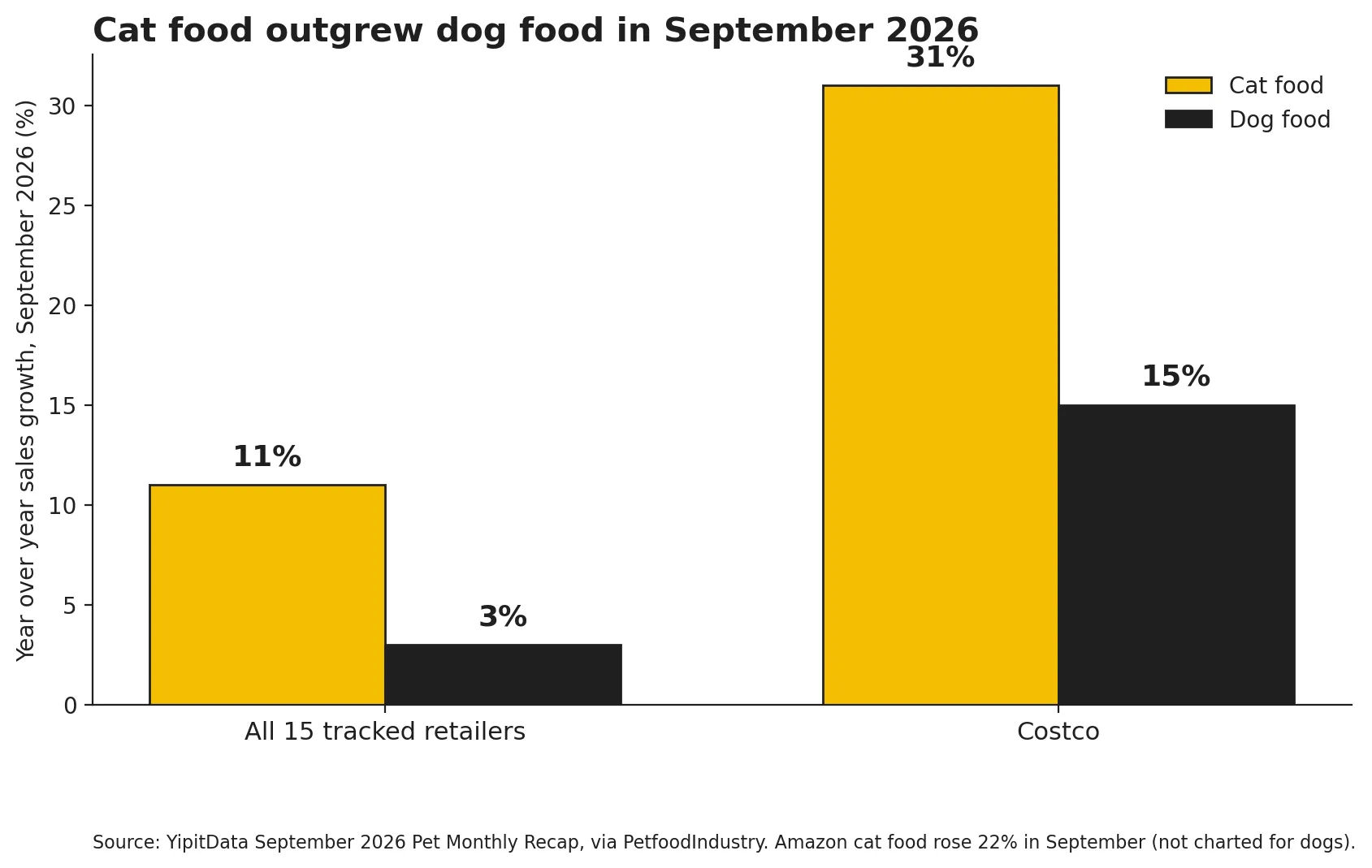
- The trend: cats are the growth engine in U.S. pet right now. In September 2026 cat food sales rose 11 percent year over year across 15 tracked retailers, compared with 3 percent for dog food, according to YipitData via PetfoodIndustry, and at Costco cat food rose 31 percent against 15 percent for dog food.
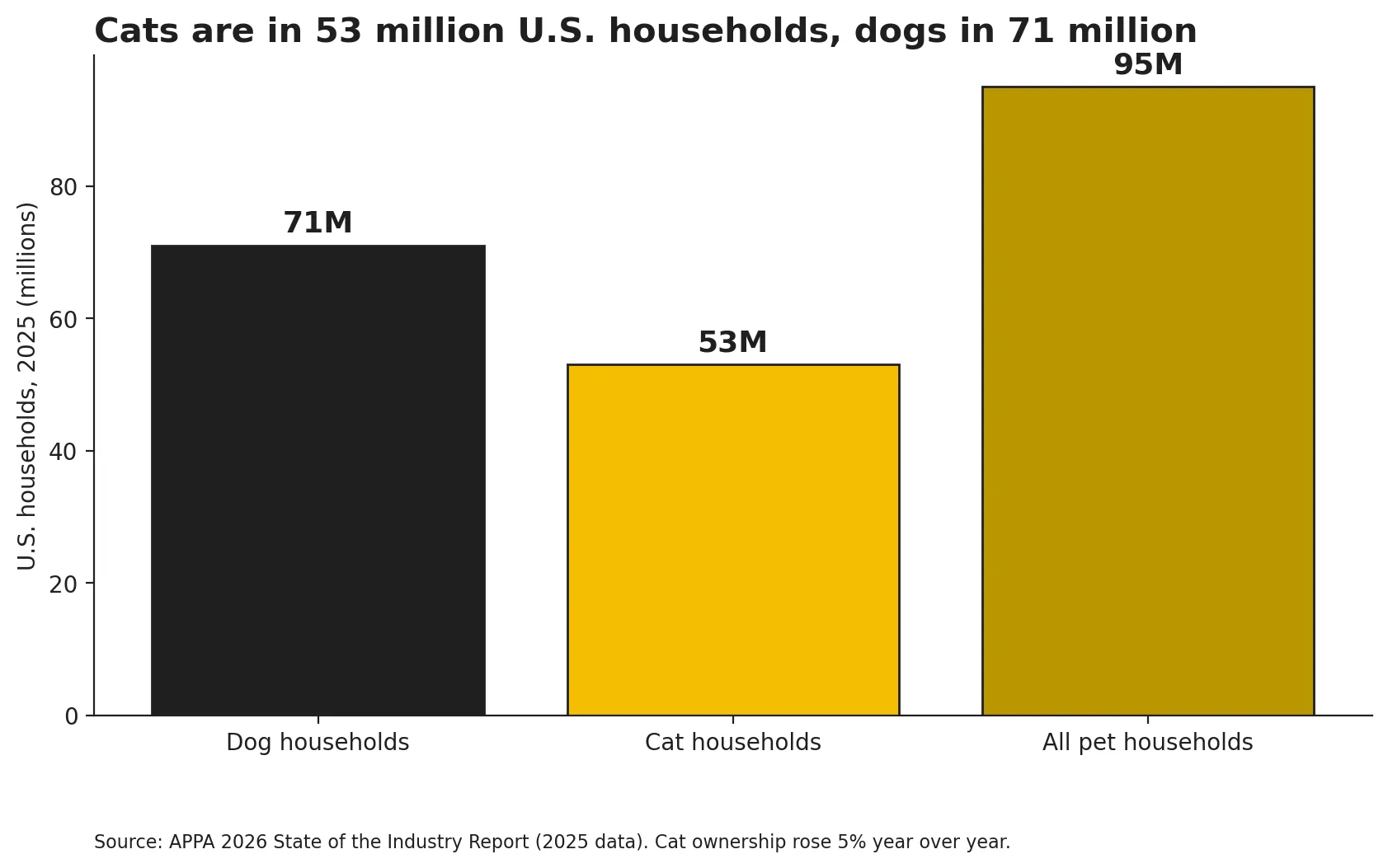
- The biggest number: 53 million U.S. households owned cats in 2025, 39 percent of all households and up 5 percent year over year, according to the American Pet Products Association (APPA), after a 23 percent surge in cat owning households in 2024. Dog ownership is still larger at 71 million households, but the direction and the depth, more multi-cat homes, are feline.
- The biggest deal signal: there is no single cat mega deal in this piece, and that is the point. Money and capacity are following cats in smaller, repeated moves: Nestlé Purina adding wet cat capacity and crediting Purina ONE, Fancy Feast and Felix for growth, Smalls expanding through Phillips Pet Food & Supplies and Fauna Foods into independent retail, and Inaba moving Churu from lickable treats into complete food at Target.
- The format story: wet, lickable and fish and seafood led September. Fish and seafood proteins grew 17 percent in cat food, poultry and lickable formats each grew 13 percent, and new premium items such as Fancy Feast Gems at Costco generated $300,000 to $500,000 in September gross merchandise value on YipitData tracking.
- The reader takeaway: if your assortment, creative and product calendar are still dog first and cat second, you are misaligned with where ownership, repeat purchase and premium growth are compounding. Build cat as its own business, with its own owner, its own formats and its own measurement, not as a smaller copy of the dog plan.
The News
September made the gap impossible to ignore
The headline data point is recent and specific. PetfoodIndustry reported on October 22, 2026 that cat food sales significantly outpaced dog food in September 2026, citing YipitData's September 2026 Pet Monthly Recap. Across all 15 tracked retailers, cat food increased 11 percent year over year in September and 11 percent year to date, compared with dog food growth of 3 percent in September and 2 percent year to date. The tracked retailers included Walmart, PetSmart, Amazon, Target, Petco, Tractor Supply, Chewy, Costco and Sam's Club, among others, and the report drew on omnichannel U.S. e-receipt, credit and debit card and web scraped data, according to PetfoodIndustry.
Costco was the sharpest example. Cat food sales there grew 31 percent year over year in September, while dog food sales rose 15 percent. Year to date, Costco cat food sales were up 45 percent. Amazon cat food sales rose 22 percent in September and 20 percent year to date. Walmart dog food, by contrast, grew 5 percent in September and 3 percent year to date, a useful reminder that dog food is not collapsing. It is growing slowly while cat food grows fast, in the same stores, in the same month, under the same consumer pressure.
Ownership is broadening, and it is getting deeper
APPA's 2026 State of the Industry Report, released in March 2026, put total U.S. pet industry expenditures at $158 billion in 2025, up 3.7 percent, with a projection of $165 billion in 2026 and full year growth near 4.4 percent, of which roughly 2 percent is inflation, according to APPA. Pet ownership remained stable at 95 million U.S. households owning at least one pet.
Inside that total, the cat figures stand out. APPA reported cat ownership increased 5 percent year over year to 39 percent of U.S. households, or 53 million households, with growth driven primarily by Gen Z and Millennials. Dog ownership expanded from 51 percent of households in 2024 to 53 percent in 2025, representing 71 million households, about 4 million additional dog owning households year over year, led by Gen Z, Millennials and Gen X.
APPA's separate 2026 Cat Report, summarised by PetfoodIndustry and Pet Food Processing in September 2026, added depth that a single ownership percentage cannot show. The growth follows a 23 percent surge in cat ownership in 2024, according to APPA. Multi-cat ownership is rising: households with two cats rose 7 percent year over year and 16 percent since 2018, and households with three or more cats increased 7 percent year over year and 45 percent since 2018. Cat owners spent an average of $337.53 on food in 2025, up 9 percent year over year, according to the report.
"Cat ownership continues to attract a broader range of consumers, and we're seeing owners become increasingly engaged in how they care for and connect with their cats."
Attribution: Pete Scott, President and CEO of APPA, in the APPA 2026 Cat Report release reported by PetfoodIndustry and Pet Food Processing.
Scott added, in the same release, that growth is not coming from just one place, with new households entering the category, existing owners expanding to multiple cats, and younger generations and male owners helping shape new expectations around care, nutrition and companionship. That sentence is commercially important. A category growing only from new households needs acquisition. A category growing from new households, plus more cats per household, plus higher food spend per owner, has three compounding drivers at once. Retailers and brands that model cat on headcount alone will under forecast volume, wet food cases, litter and consumable repeat.
53 million U.S. households owned cats in 2025, up 5 percent year over year, with households owning three or more cats up 45 percent since 2018 (APPA 2026 Cat Report).
Gen Z and cat dads are not a meme, they are a segment
The APPA Cat Report findings on who is driving growth should change creative briefs. Men account for 43 percent of all U.S. cat owners, according to APPA, with Gen Z male cat ownership rising 27 percent year over year. Multi-cat ownership among men rose 117 percent since 2018 for households with three or more cats, on the report figures summarised in the release. Purchases of mixers and toppers among male cat owners increased 214 percent since 2018, reflecting, in APPA's summary, growing interest in customization and variety. Cat dads, in the release language, devote a larger share of their pet budgets to products than female owners and increasingly embrace premium and specialized nutrition, and they are active across pet specialty, online and grocery channels.
Gen Z now represents 22 percent of cat owners, up 10 percent year over year, according to APPA. That generation, in the report summary, reports the strongest emotional connection to their cats compared with older cohorts, and ownership of three or more cats increased 14 percent among Gen Z owners. Smalls, the cat only fresh brand founded in 2017, cited a longer arc in its September 2026 campaign release: cat owning households rising from approximately 27 million in 1996 to 49 million in 2025, alongside rising visibility for cats across fashion, entertainment and internet culture. That 49 million figure is Smalls cited in its own release and differs from APPA's 53 million household figure for 2025, because sources and definitions differ. Do not blend them. The direction they share is what matters: more cat households over a long period, and a younger, more culturally visible owner base now.
The majors are already reorganizing around wet cat
Nestlé Purina is the clearest large company signal. GlobalPETS reported that Purina reported CHF 4.4 billion in sales for the first quarter of fiscal 2026, down 6.5 percent year over year in reported terms, while delivering 2.7 percent organic growth and 1.7 percent real internal growth, supported by continued strength in wet cat food. Performance was driven particularly by the super premium brands Purina ONE and Fancy Feast, despite a reversal in customer buy-in from the fourth quarter of 2025, and it was partially offset by a slowdown in dry dog food. Pricing increased 1 percent in the quarter, according to GlobalPETS reporting of Nestlé results.
Capacity is the tell that this is not only marketing language. CFO Anna Manz said, in comments reported by GlobalPETS, that improvement in PetCare is largely driven by the U.S., adding: "This is driven by additional capacity coming online, allowing us to finally service unmet demand in wet cat, where the market is growing." Manz added that Nestlé sees the same strong demand for wet cat food in Europe. When a chief financial officer explains growth as capacity finally meeting unmet wet cat demand, the constraint was supply, not interest. That changes the competitive question from who can create demand to who can manufacture, pack and distribute enough wet cat, in the right sizes, without losing quality or margin.
"This is driven by additional capacity coming online, allowing us to finally service unmet demand in wet cat, where the market is growing."
Attribution: Anna Manz, CFO of Nestlé, in comments reported by GlobalPETS on Purina wet cat food.
The majors are not discovering cats in 2026. They are allocating capacity, club packs and innovation to the part of the portfolio that is growing fastest.
Cat only brands are using the opening to get physical
Smalls is the most instructive challenger because it refused the dog first path from the start. Founded in 2017, Smalls describes itself as the nation's first cat only fresh food brand and as a brand built for cats and the people who love them, in its distribution releases. Its product lineup includes fresh, human grade nutrition, freeze dried products, treats and feeding accessories, and it says it remains focused exclusively on cats and their owners, according to PetfoodIndustry coverage of its September 2026 campaign.
In 2026 Smalls partnered with Fauna Foods to expand in New York, New Jersey and Connecticut, and separately with Phillips Pet Food & Supplies to expand nationwide through independent retailers. Jessica Morris at Phillips said in that release that Smalls represents a powerful opportunity in the fresh, cat specific nutrition space. Treat partner quotes as claims from the parties. The fact pattern, a subscription brand signing two distribution partners for independent retail, is verifiable in the releases.
Other names belong on the roster, each with a narrower, sourced role:
- Inaba Foods USA, maker of Churu, moved up 11 spots in wet cat rankings in YipitData September tracking, from No. 29 to No. 18, and announced the in store debut of Churu Complete 3 ounce cans at Target, extending a treat ritual into complete food.
- Salty Cat climbed 32 spots in wet cat, from No. 77 to No. 45, and Strongheart rose 24 spots, from No. 59 to No. 35, showing smaller wet brands can move quickly when the category expands.
- PrettyLitter built its proposition around color changing crystals that can signal urinary pH or blood, according to the company's own FAQ, a reminder that the cat economy is not only food. Multi-cat growth also sells litter and consumables on repeat.
Treats, toppers and lickables turned feeding into interaction
Format explains a lot of the growth. YipitData found cat food products with fish and seafood proteins posted 17 percent year over year sales growth in September, the fastest growing product trait in the category. Poultry proteins and lickable formats each grew 13 percent, and weight management products rose 4 percent. In dog food, by contrast, roll formats led trait growth at 23 percent, fish and seafood grew 13 percent, red meat grew 5 percent, and poultry declined 1 percent.
Lickables deserve special attention because they change the job of the product. Inaba describes Churu, its signature lickable wet treat, as designed for hand feeding to create a closer connection between pet parents and their pets, in its company releases. That is a different promise from nutrition alone. It sells a moment, repeated daily, that an owner can film, share and feel. When APPA reports mixer and topper purchases among men up 214 percent since 2018, and YipitData reports lickable formats up 13 percent in a single September comparison, they are describing the same behavior from two angles: owners adding something to the bowl, or to the hand, to personalize, bond and vary the routine.
Inaba's Target move shows where that logic leads. The company announced the in store debut of Churu Complete 3 ounce cans at Target in August 2026, with variety packs including Chicken Recipe, Chicken Recipe with Salmon and Chicken Recipe with Cheese, in gravy and mousse formats, according to its PR Newswire release. Stephanie Lundell, Director of Sales at INABA Foods USA, said in that release: "We place tremendous value on our retail partners because they help us bring meaningful innovation to pet parents at scale. Target is an ideal partner for the in store debut of Churu Complete 3oz Cans." A treat brand using a trusted ritual to enter complete food, launching first with a mass retailer, is a classic category expansion play, and it only works if the ritual is already habitual.
"We place tremendous value on our retail partners because they help us bring meaningful innovation to pet parents at scale."
Attribution: Stephanie Lundell, Director of Sales at INABA Foods USA, in the company's Target launch release for Churu Complete.
Functional treats follow the same path. Dataintelo reported lickable and wet treats growing at 9.4 percent a year in its market summary, and hydration and urinary support as the fastest function at 9.9 percent. Those are Dataintelo's reported rates for its defined market, not scanner sales, and should be used as directional research. The ordering is still useful: the fastest functions are cat specific problems, hydration, urinary and hairball, that dog products do not solve in the same way.
Why It Matters
Cats fit the housing and schedule reality of younger owners
APPA does not, in the releases cited here, prove why Gen Z and Millennials are choosing cats at higher rates, and this piece will not invent a reason as fact. What the ownership pattern is consistent with, and what founders should test in their own customer research, is a fit between cats and smaller living spaces, more independent daily care, and households that add a second pet more easily when that pet is a cat. The multi-cat figures are the strongest internal evidence: adding a second or third cat is a lower friction expansion of the household than adding a second or third dog for many owners, and APPA shows that expansion happening, up 7 percent in a year for both two cat and three plus cat households, and up 45 percent since 2018 for three plus.
Picky is pricing power, if the format earns it
Picky creates variety seeking. An owner whose cat rejects a flavor does not stop spending, she rotates, adds a topper, tries a lickable, or trades up to a brand the cat will eat consistently. That behavior supports more SKUs, smaller pack trial, variety packs and premium wet, and it punishes brands with a narrow flavor set. It also raises the cost of failure: a formula change communicated poorly, or chronic out of stock on the one flavor a cat will eat, can lose a household that a dog brand might retain through substitution. Cat operators need tighter palatability testing, clearer transition guidance and flavor level sales reporting.
Wet cat is a capacity and cold and can business, not only a brand business
Wet food brings manufacturing constraints that dry food does not. Nestlé talking about capacity coming online to meet unmet wet demand, and investing in new pet food plants in other reporting, points to a simple truth: wet cat growth will be won by companies that secure cans, pouches, retort capacity, fish and poultry supply, and club and mass distribution at the same time. Fancy Feast Gems, sold in a 2 ounce, 40 count pack at Costco, generated $300,000 to $500,000 in September GMV on YipitData tracking of newly observed products. That is a club pack doing premium trial at scale. Friskies share of Costco wet cat trailing 12 month GMV rose from 9 percent to 42 percent, while Kirkland Signature fell from 91 percent to 56 percent, according to YipitData. Those shares are for Costco wet cat on that data set, not for the total market, and they show how quickly a branded value brand can take share in a growing category when a private label's earlier dominance normalizes.
Cat food sales rose 31 percent at Costco and 11 percent across all tracked retailers in September 2026, compared with dog food at 15 percent and 3 percent (YipitData via PetfoodIndustry).
The Numbers
Market size, with definitions kept separate
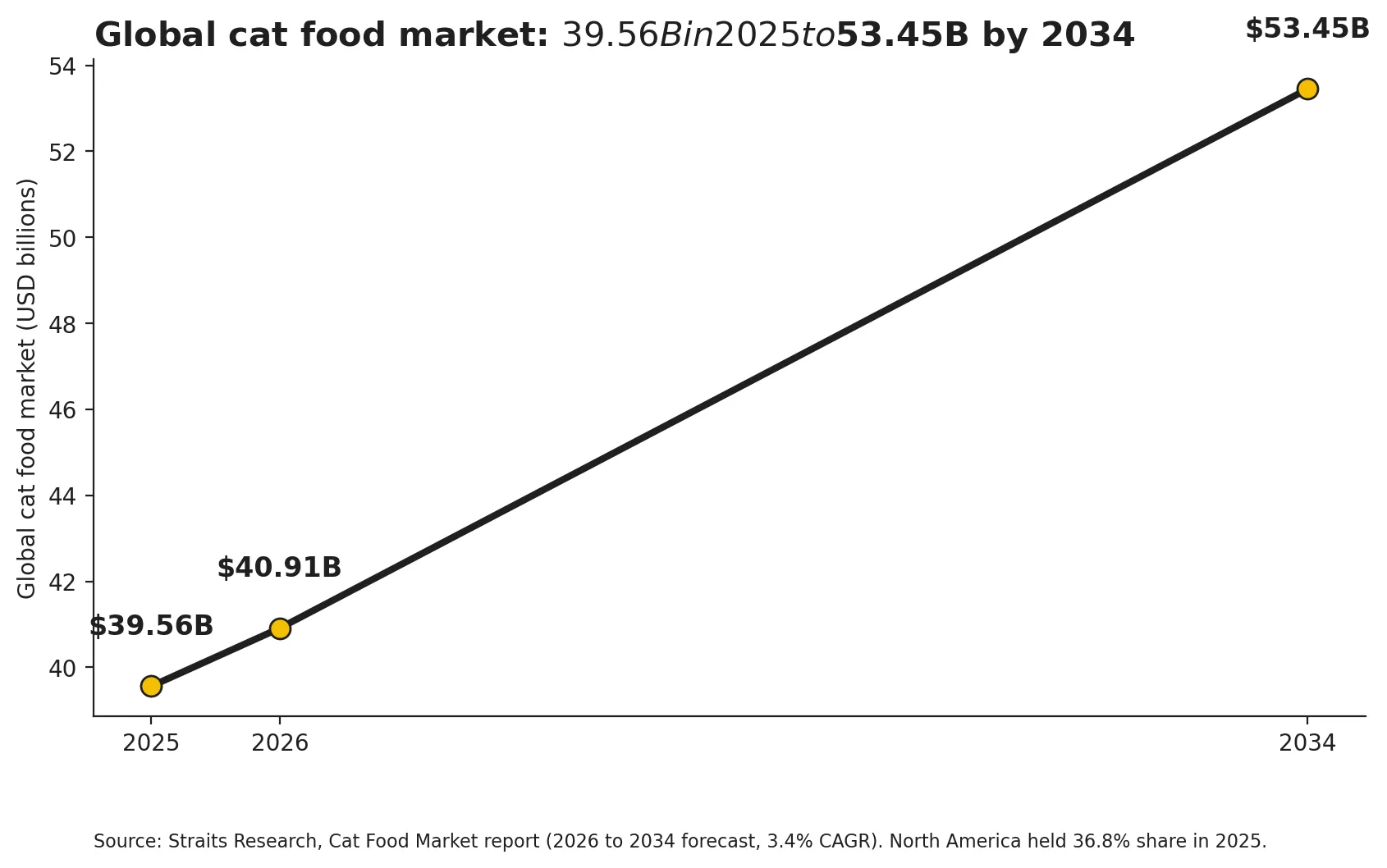
Straits Research valued the global cat food market at $39.56 billion in 2025, projecting growth from $40.91 billion in 2026 to $53.45 billion by 2034 at a 3.4 percent compound annual growth rate, with North America holding a 36.8 percent share in 2025, according to its report summary. Knowledge Sourcing, in a separate forecast, put the global cat food market at $43.0 billion in 2026 rising to $52.6 billion by 2031 at a 4.1 percent CAGR, with wet cat food accounting for about 47 percent of global market revenue in 2026 and premium cat food growing at about 5.6 percent annually through 2031, according to its report summary. Those two forecasts use different bases, periods and definitions, so do not average them or plot them as one series. Together they show a large global market, a North American weight well above a third, and wet and premium growing faster than the total.
Sales growth and ownership, the two core charts
- Cat food, all tracked retailers: up 11 percent in September and 11 percent year to date
- Dog food, all tracked retailers: up 3 percent in September and 2 percent year to date
- Cat food, Costco: up 31 percent in September and 45 percent year to date
- Dog food, Costco: up 15 percent in September and 10 percent year to date
- Cat food, Amazon: up 22 percent in September and 20 percent year to date
- Fish and seafood cat proteins: up 17 percent in September, lickable formats up 13 percent
- Total U.S. pet industry: $158 billion in 2025, projected $165 billion in 2026 (APPA)
- Cat households: 53 million, 39 percent of households, up 5 percent (APPA)
- Dog households: 71 million, 53 percent of households (APPA)
- Average cat owner food spend: $337.53 in 2025, up 9 percent (APPA Cat Report)
- Men as share of cat owners: 43 percent, Gen Z as share: 22 percent (APPA Cat Report)
- Mixer and topper purchases among men: up 214 percent since 2018 (APPA Cat Report)
Average cat owner food spend rose 9 percent to $337.53 in 2025 (APPA 2026 Cat Report).
Company figures, reported as reported
- Nestlé Purina PetCare: CHF 4.4 billion in first quarter fiscal 2026 sales in GlobalPETS reporting, 2.7 percent organic growth, wet cat strength led by Purina ONE and Fancy Feast; first half organic growth 2.7 percent and third quarter organic growth 5.3 percent in later Nestlé reporting summaries, with cat brands Pro Plan, ONE and Felix cited
- Smalls: over 1,000 retail doors and growing at September 2026 campaign coverage (company via PetfoodIndustry), distribution partnerships with Phillips Pet Food & Supplies and Fauna Foods in 2026, total funding of $34 million in earlier TechCrunch reporting summarised in market coverage, with a $19 million Series B as part of that total; use the funding figure as historical reported funding, not as a 2026 raise
- Inaba: wet cat ranking up 11 places to No. 18 in YipitData September, Churu Complete launching first in store at Target, available at Amazon, Chewy, Petco, Walmart, Target and PetSmart among others in company releases
- Fancy Feast Gems at Costco: $300,000 to $500,000 in September GMV for the newly observed 2 ounce, 40 count pack (YipitData)
- Friskies at Costco wet cat: trailing 12 month GMV share up from 9 percent to 42 percent, Kirkland Signature down from 91 percent to 56 percent (YipitData, Costco wet cat only)
What It Means For You
If you run a food or treat brand
Give cat its own P and L, its own palatability testing and its own flavor calendar. Start by auditing how many of your best sellers are truly cat specific: urinary, hairball, hydration, indoor, senior cat, kitten, picky eater rotation, lickable bonding. If the answer is a dog formula in a smaller bag, you have a gap the data now punishes. Build two cat specific rituals, not ten generic SKUs. A daily topper or lickable plus a wet rotation is a more defensible start than a full line extension you cannot keep in stock.
Copy the Inaba sequence in principle, not in product. Earn a habitual, low price, high frequency ritual first, then use trust from that ritual to enter a higher value daily job such as complete food. Copy the Smalls sequence in channel: prove repeat in subscription or direct, then sign distribution that puts you in independent stores where staff can explain why a cat only fresh product is different. Do not sign distribution before you can supply variety packs consistently. A picky cat household that finds its flavor out of stock twice will not wait for your next production run.
Brief creative to the buyer who is actually growing. Test cat dad and Gen Z creative as primary, not as a variant. Show hand feeding, rotation, multi-cat households and the humor and independence Smalls put at the center of "Is Cat", in your own language, not theirs. Measure mixer and topper attach rate by segment. APPA's 214 percent rise in men's topper purchases since 2018 suggests the personalization sale is not a niche add on. It is the entry point for a segment that will then trade up.
If you run a retailer or a marketplace store
Rebalance space by growth, not by historic share. Dog is still larger, and this piece does not suggest cutting dog. It suggests that wet cat, lickables, toppers and cat functional treats deserve test space, endcaps and search placement proportional to an 11 percent growth category, not to last year's planogram. At Costco, cat grew 31 percent. At Amazon, cat grew 22 percent in September. Your own data will differ, so run the same comparison in your store: cat versus dog sales growth, by format, for the last 90 days, and show it to your buyer team in one page.
Merchandise the household system. Put wet variety packs, lickables, hairball and urinary support, litter and monitoring together in a cat household solution, in store and in a single online collection, with multi-cat quantity guidance. A two cat and three cat household is a different basket, and APPA shows both growing 7 percent in a year. Offer a good, better, best ladder inside cat, as value pressure is real across pet, with 22 percent of owners spending less in 2025 in APPA State of the Industry reporting, up from the prior year. Premium cat can grow while value cat also grows, as Friskies at Costco shows. A retailer with only premium cat will lose the value household, and a retailer with only value cat will lose the topper and wet premium household.
If you are a founder, investor or corporate development lead
Underwrite cat on cohort behavior, not on a market CAGR alone. Ask for repeat by number of cats in the household, flavor rotation breadth per household, topper attach rate, wet versus dry mix shift over time, and retention when a household adds a second cat. Those metrics will tell you whether a brand benefits from the multi-cat compounding APPA describes, or whether it sells once to a single cat and churns.
Watch for consolidation to follow capacity. Fresh food last week showed subscription leaders becoming buyers. Cat has not yet produced the same headline deal in the sources here, but the ingredients are present: cat only brands with over 1,000 doors, treat brands entering complete food, majors adding wet capacity, and emerging wet brands jumping dozens of ranking places in a year. A buyer will eventually pay for a cat ritual, a flavor library and a household file that it cannot build quickly. Founders who build those assets cleanly, with flavor level repeat data, will have the comparable when that moment arrives.
What To Watch
Whether September was a month or a run rate
Watch October through December reporting. If cat holds double digit growth across tracked retailers while dog stays low single digit, the gap is a run rate, not a September anomaly. A single month built this piece's news hook. A quarter will confirm or revise it.
Wet capacity, club packs and private label response
Smalls and the cat only challengers in retail
Watch Smalls door count after the Phillips and Fauna partnerships, whether its television and out of home investment converts to retail repeat, and whether it extends credibly beyond food into litter, bowls and other cat household jobs without losing focus. Watch Salty Cat, Strongheart and other emerging wet brands: ranking jumps are easy in a growing category, holding a ranking for two quarters is harder. Watch Wellness and other wellness brands adding cat specific treats, and whether functional claims in hydration and urinary support gain veterinary backing that owners can verify.
The owner file: Gen Z, men and multi-cat households
Finally, watch price. APPA put about 2 points of projected 2026 industry growth down to inflation, and 22 percent of owners spent less in 2025. Cat premium is growing, and cat value is growing at Costco through Friskies. The brands and retailers that win the next year will be the ones that hold both ends honestly: a premium wet, fresh or functional offer that a picky cat actually eats, and a value offer that lets a multi-cat household stay in the category without trading down in trust. That is the cat economy in one sentence: more cats, more cats per home, more daily rituals per cat, and a shelf that is finally being built for that reality.
Sources
- PetfoodIndustry, Report: In September, cat food sales outpace dog food (October 22, 2026), reporting YipitData September 2026 Pet Monthly Recap: https://www.petfoodindustry.com/pet-food-market/market-trends-and-reports/news/15838249/report-in-september-cat-food-sales-outpace-dog-food
- APPA, U.S. Pet Industry Reaches $158 Billion in 2025, Poised for Continued Growth in 2026 (March 26, 2026): https://americanpetproducts.org/news/u.s.-pet-industry-reaches-158-billion-in-2025-poised-for-continued-growth-in-2026?hs_amp=true
- PetfoodIndustry, Report: Cat ownership grows to 53 million U.S. households, reporting APPA 2026 Cat Report: https://www.petfoodindustry.com/pet-food-market/market-trends-and-reports/news/15834866/report-cat-ownership-grows-to-53-million-us-households
- Pet Food Processing, Cat ownership climbs as Gen Z, cat dads fuel growth, reporting APPA 2026 Cat Report: https://www.petfoodprocessing.net/articles/20901-cat-ownership-climbs-as-gen-z-cat-dads-fuel-growth
- GlobalPETS, Wet cat food demand offsets broader slowdown in Nestlé's pet business (April 27, 2026): https://globalpetindustry.com/news/wet-cat-food-demand-offsets-broader-slowdown-in-nestles-pet-business/
- PetfoodIndustry, Purina pet food growth, capacity in focus as Nestlé speaks at Barclays (September 2026): https://www.petfoodindustry.com/business-strategy/news/15834424/purina-pet-food-growth-capacity-in-focus-as-nestl-speaks-at-barclays
- PetfoodIndustry, Smalls launches largest brand campaign for cat category (September 21, 2026): https://www.petfoodindustry.com/pet-food-marketing-and-branding/news/15835350/smalls-launches-largest-brand-campaign-for-cat-category
- Pets Plus, Smalls Partners with Phillips Pet Food & Supplies to Further Expand Distribution: https://petsplusmag.com/smalls-partners-with-phillips-pet-food-supplies-to-further-expand-distribution/
- EIN Presswire, Smalls, the Nation's First Cat-Only Fresh Food Brand, Partners with Fauna Foods to Expand Distribution to NY, NJ, and CT: https://www.einpresswire.com/article_print/892956895/smalls-the-nation-s-first-cat-only-fresh-food-brand-partners-with-fauna-foods-to-expand-distribution-to-ny-nj-and-ct
- PR Newswire, INABA Foods USA Announces In-Store Debut of Churu Complete 3oz Cans at Target (August 31, 2026): https://www.prnewswire.com/news-releases/inaba-foods-usa-announces-in-store-debut-of-churu-complete-3oz-cans-at-target-302862183.html
- Straits Research, Cat Food Market Size, Share, Growth, Analysis, Report, 2034: https://straitsresearch.com/report/cat-food-market
- Knowledge Sourcing, Cat Food Market Forecast from 2026 to 2031: https://www.marketresearch.com/Knowledge-Sourcing-Intelligence-LLP-v4221/Cat-Food-Forecast-44068679/
- Dataintelo, Cat Treats Market Size, Share & Forecast Report 2025 to 2034: https://dataintelo.com/report/global-cat-treats-market
- PrettyLitter Canada, Cat Litter Frequently Asked Questions (company FAQ on health monitoring): https://www.prettylitter.ca/faq