The Healthcare Land Grab: Clinics, Diagnostics and AI Are Where Pet Money Is Moving
Veterinary care was the second largest revenue line in US pet last year, and in a single week in November the industry showed every way it plans to own more of it, from a 300 specialist acquisition to a diagnostics beat and a drug giant going backwards.
By Good Company Editorial Desk
The Short Version
- The trend: pet healthcare is becoming an integrated business, not a collection of clinics. Retailers are buying clinics, clinic groups are consolidating specialty care, diagnostics companies are buying the AI layer inside the practice, and insurers are racing to finance the bill.
- The biggest number: veterinary care commanded $40 billion in the United States last year, the second highest revenue line in the sector, up almost 21 percent over five years, according to American Pet Products Association (APPA) data reported by GlobalPETS on November 4, 2026.
- The biggest deal this week: Animal Outpatient Specialty Network (AOSN) acquired a portfolio of outpatient specialty practices on November 3, 2026, creating what the company calls the nation's largest dedicated outpatient veterinary specialty business, with over 300 veterinary specialists and residents nationwide. Terms were not disclosed.
- The split that explains everything: in the third quarter, IDEXX grew revenue 10 percent on diagnostics demand while Zoetis companion animal revenue fell 5 percent. The money is moving from products sold through the clinic to services, tests and software delivered in it.
- The reader takeaway: if your business touches a vet visit, a diagnosis, a prescription or the payment for one, you are no longer in an adjacent category. You are in the main event, and the platforms integrating all four are setting the terms.
The News
A specialty network gets built in one transaction
On November 3, 2026, Newport Beach, California based Animal Outpatient Specialty Network announced the acquisition of a portfolio of outpatient specialty practices, including certain Arizona Veterinary Dental Specialists, Dermatology for Animals, Eye Care for Animals, and Veterinary Cancer Group clinics. The company says the deal establishes AOSN as the nation's largest dedicated outpatient veterinary specialty business, with over 300 veterinary specialists and residents nationwide.
The structure matters as much as the scale. AOSN is not a general practice roll-up. Its network spans six specialty lines on an outpatient model, and the company says it runs the nation's largest residency program in outpatient veterinary specialty medicine. Specialty and referral care is where the highest value cases concentrate, and where general practices send work they cannot do themselves. Owning the referral destination and the specialist pipeline that staffs it is a different asset than owning exam rooms.
These are outstanding practices with talented teams, trusted brands, and deep roots in the communities they serve. We have tremendous respect for what these practices have accomplished and are excited to welcome them to AOSN. Together, we have the opportunity to set a new standard for outpatient veterinary specialty care, where specialists can build exceptional careers, continue developing their skills, and deliver the highest quality care to their patients.
Steven Mrha, Chief Executive Officer of AOSN, in the November 3, 2026 announcement.
Financial terms were not disclosed. That is normal for this layer, which makes the operating signals, specialist counts, residency pipelines, and referral relationships, more informative than deal headlines.
The same week, the scoreboard split in public
Two public companies reported third quarter results within days of the AOSN deal, and together they draw the map of where healthcare money is going.
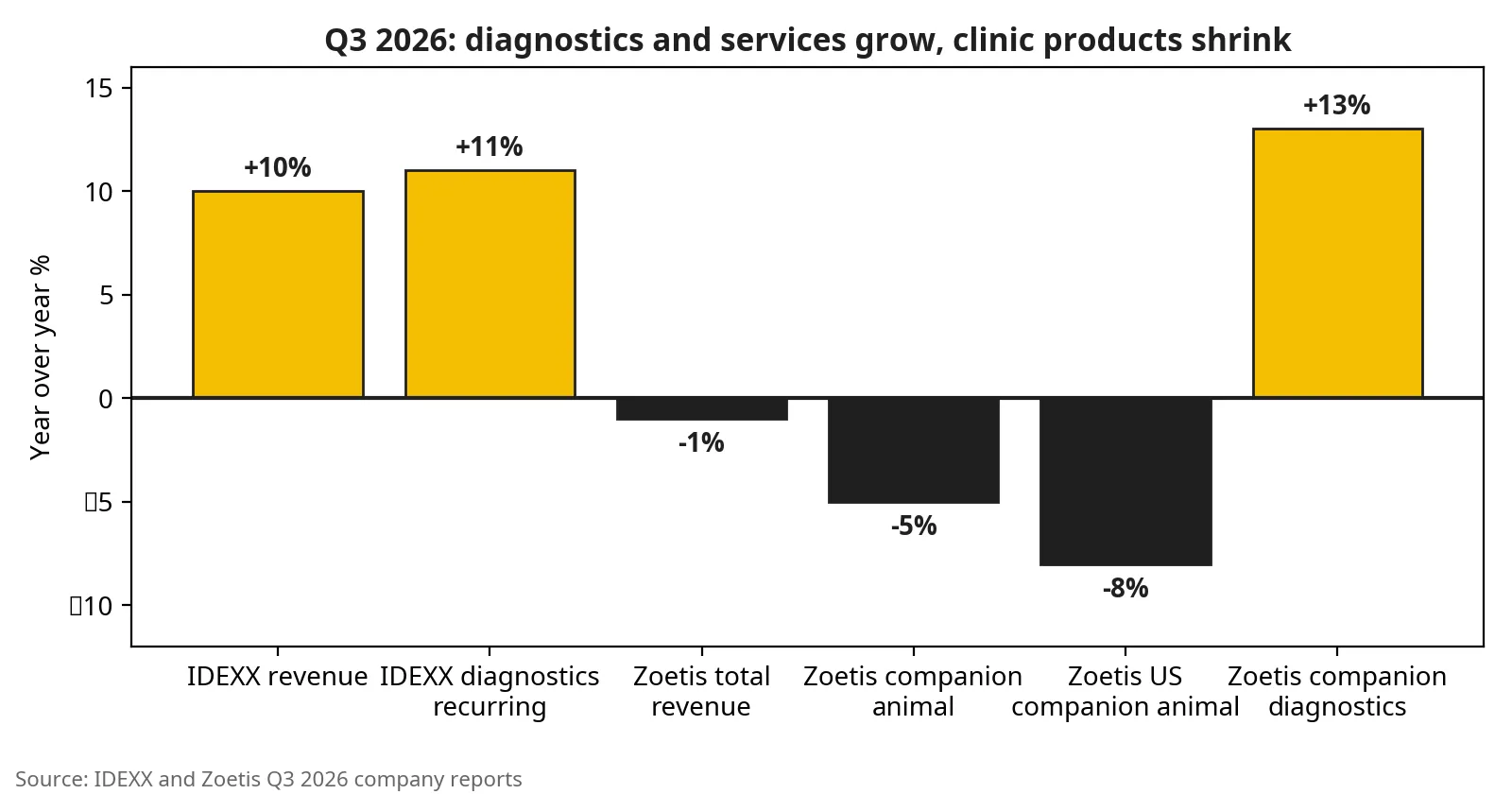
IDEXX Laboratories reported third quarter 2026 revenue of $1.214 billion, up 10 percent, with earnings per share of $4.01, up 18 percent. Companion Animal Group Diagnostics recurring revenue reached $967 million, growing 11 percent organically, and the company placed more than 1,900 inVue Dx instruments. IDEXX raised its full year revenue guidance to $4.741 billion to $4.767 billion, while trimming its margin outlook partly on acquisition impacts including CoVet, the AI workflow company it acquired on September 16, 2026.
Zoetis reported the mirror image on November 4, 2026. Third quarter revenue was $2.4 billion, down 1 percent. United States revenue fell 6 percent to $1.2 billion, with US companion animal revenue down 8 percent to $980 million, which the company attributed to macro driven price sensitivity, competitive pressure in dermatology, and generic competition. Total companion animal revenue fell 5 percent to $1.565 billion. Livestock and diagnostics cushioned the quarter, and companion animal diagnostics grew 13 percent globally to $122 million.
Continued pressure in Companion Animal was partially offset by growth in Livestock and Diagnostics, reflecting the breadth of our portfolio.
Zoetis, in its third quarter 2026 results release, November 4, 2026.
Read the two reports together and the pattern is not that pet healthcare is booming or struggling. It is that the visit itself is being repriced. AVMA data reported by GlobalPETS shows US practice revenue up 3.3 percent from August 2025 to August 2026 while visits fell 2.1 percent. Inside that revenue, services grew 2.8 percent while product sales at practices fell 3.3 percent. Fewer visits, more services and testing per visit, fewer products bought at the counter.
The retailer already made its clinic bet, and it is bigger than most people priced in
The largest strategic move in this trend did not happen this week. It happened in April, and November is when its scale becomes the context for everything else. On April 8, 2026, Chewy announced a definitive agreement to acquire Modern Animal, a technology forward veterinary platform with 29 owned clinics, 24/7 virtual care, and a membership model. Chewy said the deal would add over $125 million in annualized run rate revenue and scale Chewy Vet Care from 18 to 47 locations nationwide, with Modern Animal bringing over 100,000 member families.
Chewy said Modern Animal clinics deliver over 2x above industry average revenue per location and EBITDA margins exceeding 20 percent for mature clinics, maturing over two to four years. Chewy estimated integration would lift net sales per active customer by approximately 15 to 20 percent, and said the deal would be EBITDA dollar neutral in 2026 on a pro forma basis, with contribution beginning in 2027.
Modern Animal perfectly complements our strategy to become the preeminent end-to-end pet health ecosystem, utilizing both owned and asset-light models. We are acquiring a high-growth platform with positive 4-wall EBITDA at the clinic level, a best-in-class operating engine, and over 100,000 member families. This deal accelerates our Vet Care expansion, drives higher long-term customer value, and creates a clear competitive moat in the industry.
Sumit Singh, Chief Executive Officer of Chewy, in the April 8, 2026 acquisition announcement.
We're excited to welcome Modern Animal to Chewy as we advance our vision for the future of pet healthcare. The joining of Modern Animal's best-in-class operating systems and clinical expertise with Chewy's unparalleled customer acquisition and engagement engines creates an industry-leading, high ROI business almost immediately.
Mita Malhotra, President of Chewy Health, in the same announcement.
By June 2026, analyst coverage described the Modern Animal acquisition as completed, with the combined business expected to operate approximately 60 clinics by the end of fiscal 2026, an estimated $70 million revenue contribution in fiscal 2026, and steady state revenue approaching $290 million. Chewy frames the prize plainly: veterinary services represented an approximately $40 billion market in 2025, growing at roughly 5 percent annually, inside a broader health addressable market of approximately $54 billion including in-clinic products. Against that, Chewy brings over 21 million active customers and a scaled pharmacy platform. The clinic is not the business. It is the front door.
The software and AI layer is being bought, not built
IDEXX's September 16, 2026 acquisition of Toronto based CoVetAI is the software version of the same move. CoVet provides AI native ambient listening and clinical workflow software, capturing information from consultation to treatment planning and follow up. IDEXX said CoVet will be integrated into its software ecosystem, which already reaches more than 10,000 clinics globally, and will continue to support other scribe solutions and non IDEXX systems. Terms were not disclosed. IDEXX quantified the trade: CoVet is expected to contribute $5 million in revenue for 2026 while causing $0.13 per share in dilution. That is a platform buying distribution inside the exam room, and accepting a visible earnings cost to do it.
The independent software layer is consolidating around the same insight. Industry rankings published November 3, 2026 put Petvisor at the top of pet tech fundraising with $100 million raised, with Otto, the Austin workflow platform, among the largest raisers at about $48 million to $50 million. Whoever owns the workflow owns the moment where a test is ordered, a refill is approved, and a recheck is booked.
At the earliest stage, investors are funding stranger frontiers of the same thesis. On November 3, 2026, Janus Labs AI closed a $1.8 million pre-seed round led by New York Angels, bringing its total raised to $2.6 million. The company says its patented contactless Neuro AI technology measures brain activity in dogs and cats without physical contact, combining neural readings with physiological data to flag early health changes. The concept is speculative and unproven at scale, and the round is small, but it shows pre-seed money still arriving for pet health sensing that does not exist as a category yet.
Insurance is the financing layer catching up
Care this expensive needs a payer, and the payer layer is growing fast, from a small base. NAPHIA reported in its 2026 State of the Industry Report that 7.6 million pets are now insured across North America, with insured counts up 9 percent in the United States and up 3.9 percent in Canada. United States gross written premium reached $5.2 billion in 2025, up 20.8 percent, meaning premium revenue is growing more than twice as fast as enrollment.
The gap is the opportunity and the warning. Only 4.27 percent of US pets are insured, 5.99 percent of dogs and 2.29 percent of cats. In Canada, 3.72 percent of pets are insured, 5.64 percent of dogs and 1.91 percent of cats. More than 95 percent of US pets still have no coverage, while GlobalPETS reported owners are increasingly apprehensive about consultation and treatment costs, and AVMA data shows visits already falling.
The companies in this trend
Clinic owners and consolidators:
- Chewy and Modern Animal (United States): 29 clinics acquired, Vet Care scaling from 18 to 47 locations, approximately 60 expected by the end of fiscal 2026 per analyst coverage, over $125 million run rate revenue, over 100,000 member families.
- Animal Outpatient Specialty Network (United States): portfolio acquisition November 3, 2026, over 300 specialists and residents, six specialty lines, terms not disclosed.
- GoodVets (United States): absorbed WellHaven's 40 plus hospitals earlier this year, taking its network past 116 hospitals.
Diagnostics, medicines and health products:
- IDEXX Laboratories (United States, with Toronto based CoVet): Q3 revenue $1.214 billion, up 10 percent, diagnostics recurring revenue $967 million, up 11 percent, guidance raised, CoVet acquired September 16, 2026, terms not disclosed.
- Zoetis (United States): Q3 revenue $2.4 billion, down 1 percent, US companion animal down 8 percent to $980 million, diagnostics up 13 percent globally to $122 million.
- Hill's Pet Nutrition (United States): grew 5.6 percent in the third quarter on therapeutic and cat diets, the food side of the healthcare thesis.
Software, AI and early stage health:
- CoVetAI (Canada): AI ambient listening and clinical workflow, acquired by IDEXX, $5 million expected 2026 revenue, $0.13 per share dilution per IDEXX.
- Petvisor (United States): veterinary and pet business software, $100 million in total funding, the largest pet tech fundraiser in the November 3, 2026 industry ranking.
- Otto (United States): clinic communication and workflow platform, about $48 million to $50 million raised, now adding AI documentation.
- Janus Labs AI (United States): $1.8 million pre-seed closed November 3, 2026, $2.6 million total raised, contactless neural monitoring for dogs and cats, nine US patents per the company.
Financing and payment:
- Pet insurance (United States and Canada): 7.6 million insured pets, US premium $5.2 billion in 2025, up 20.8 percent, penetration 4.27 percent US and 3.72 percent Canada, per NAPHIA.
Why It Matters
The visit is shrinking in count and growing in value, and that reprices every supplier
AVMA data reported by GlobalPETS puts the tension in three numbers: practice revenue up 3.3 percent, visits down 2.1 percent, and product sales at practices down 3.3 percent, while services rose 2.8 percent. APPA data in the same GlobalPETS analysis shows veterinary care at $40 billion in the US last year, up only 2.5 percent year over year but almost 21 percent over five years, with a 5.1 percent accumulated yearly inflation rate for the vet category in July. Medication subscription purchases grew 14 percent last year, even as counter sales fell.
That is a market growing by price and intensity, not by traffic. For a diagnostics company, intensity is revenue: more tests per visit is exactly IDEXX's 11 percent recurring diagnostics growth. For a drug company, fewer visits and price sensitive owners are a headwind: exactly Zoetis's 8 percent US companion decline. For a brand, the clinic counter is a shrinking shelf, while the test menu, software workflow, and follow up automation are growing shelves that belong to someone else.
Stat callout: US veterinary care reached $40 billion last year, up almost 21 percent over five years, while vet visits fell 2.1 percent in the year to August 2026 (APPA and AVMA data via GlobalPETS).
Consolidation is splitting into two games: the front door and the referral destination
Chewy buying Modern Animal and AOSN assembling specialty practices look like the same consolidation story. They are opposite ends of it. Chewy wants the front door: high frequency primary care and memberships that route food, pharmacy, and follow up spending through its ecosystem. AOSN wants the destination: low frequency, high value specialty cases that general practices refer out, staffed by specialists who are scarce and hard to recruit, which is why its residency program is a strategic asset and not a training footnote.
Both games punish the independent middle. A standalone general practice now competes for the front door with a retailer that can acquire customers at national scale, and refers its most valuable cases into networks consolidating the specialists it depends on. None of this makes independent practice unviable. It makes its previous advantages, local reputation and referral habit, easier for scaled networks to buy than they used to be.
AI in the clinic is not a feature race, it is a workflow land claim
CoVet's value to IDEXX is not that an AI scribe saves documentation time. It is that the scribe sits at the start of the clinical record, where the history is taken, the plan is formed, and the diagnostics are chosen. IDEXX already sells the tests and reaches more than 10,000 clinics globally. The $5 million of expected 2026 CoVet revenue is trivial against $1.214 billion of quarterly revenue. The $0.13 per share of dilution IDEXX accepted, and disclosed, is the tell: this was bought for position, not for this year's income statement.
For software founders, the lesson is that the buyer set has changed. A workflow tool is no longer valued only on clinic subscriptions. It is valued on which ecosystem it completes, and the ecosystems are being assembled now.
Stat callout: IDEXX grew third quarter revenue 10 percent to $1.214 billion while Zoetis US companion animal revenue fell 8 percent to $980 million (company reports, November 2026).
The payer problem is the ceiling on the whole trend
Every part of this land grab assumes owners keep saying yes to care. Vet category inflation ran at 5.1 percent on an accumulated yearly basis in July, per APPA data reported by GlobalPETS. Visits are already down 2.1 percent, and Zoetis named macro driven price sensitivity first among the causes of its US companion decline. Insurance penetration of 4.27 percent means almost every specialty bill AOSN's network sells is still paid out of pocket, at the counter, by an owner who did not budget for it.
That is why the membership model matters beyond Chewy's deal math, why insurance premium growth of 20.8 percent matters beyond the insurers, and why subscription medication purchases growing 14 percent matters beyond pharmacy. The winners will not only own care delivery. They will own a way for owners to prepay, subscribe, or insure it.
The Numbers
The market
- $158 billion: total US pet industry expenditures in 2025, up 3.7 percent, according to APPA
- $165 billion: APPA's projected US expenditures for 2026
- $40 billion: US veterinary care revenue last year, the sector's second highest line, up 2.5 percent year over year and almost 21 percent over five years, per APPA data via GlobalPETS
- $41 billion in 2025, rising to a projected $42.4 billion in 2026: APPA's vet care and product sales category
- $42.4 billion context: pet food and treats, the largest category, is projected at $69.7 billion in 2026 by APPA, so healthcare is the second engine, not a side line
- 5.1 percent: accumulated yearly inflation for the US vet category in July, per APPA data via GlobalPETS
- Plus 3.3 percent revenue, minus 2.1 percent visits: AVMA tracking of US practices, August 2025 to August 2026, with services up 2.8 percent and product sales at practices down 3.3 percent
- Plus 14 percent: growth in subscription purchases of medications in the US last year, per APPA data via GlobalPETS
- 95.4 million: US households owning at least one pet, per APPA's 2026 National Pet Owners Survey
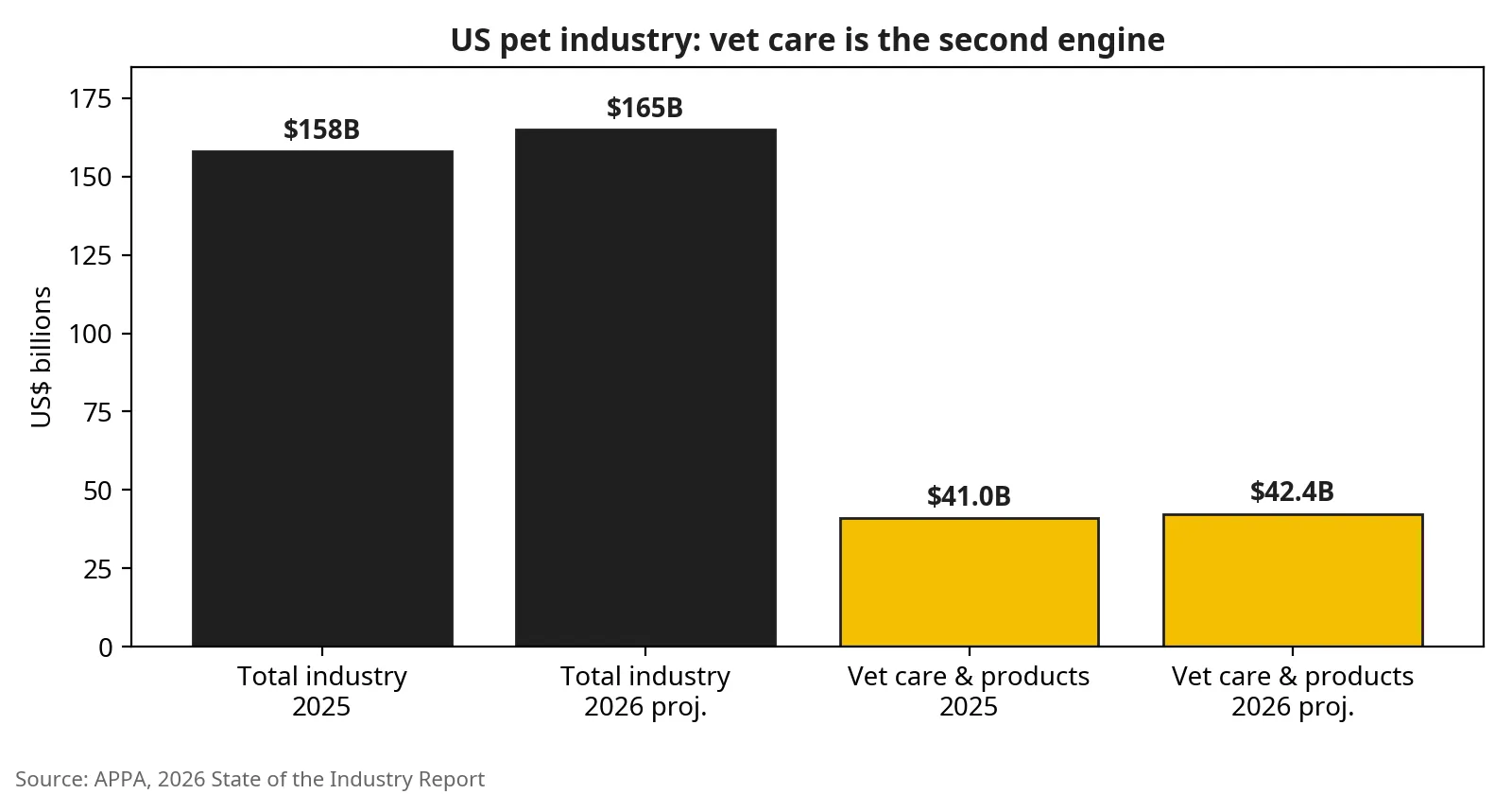
Stat callout: APPA projects vet care and product sales of $42.4 billion in 2026, inside a $165 billion US pet industry (APPA).
The deal and earnings scoreboard
- Over 300: veterinary specialists and residents in AOSN's network after its November 3, 2026 portfolio acquisition, across dentistry and oral surgery, dermatology, internal medicine, oncology, ophthalmology, and surgery, terms not disclosed
- 29 clinics, 18 to 47 locations, over $125 million: Modern Animal's clinic count, the resulting Chewy Vet Care footprint, and the annualized run rate revenue Chewy disclosed in April 2026, with approximately 60 clinics expected by the end of fiscal 2026 per analyst coverage
- Over 100,000: Modern Animal member families, per Chewy
- Over 2x industry average revenue per location, and over 20 percent mature clinic EBITDA margins: Modern Animal unit economics disclosed by Chewy
- 15 to 20 percent: Chewy's estimated uplift in net sales per active customer from integrating Modern Animal into its ecosystem
- $40 billion, growing at roughly 5 percent annually: Chewy's stated size for the 2025 veterinary services market, inside an approximately $54 billion health addressable market including in-clinic products
- $1.214 billion, up 10 percent: IDEXX third quarter 2026 revenue, with earnings per share of $4.01, up 18 percent
- $967 million, up 11 percent organically: IDEXX Companion Animal Group Diagnostics recurring revenue in the third quarter, with more than 1,900 inVue Dx placements
- $4.741 billion to $4.767 billion: IDEXX raised full year 2026 revenue guidance, with earnings per share guidance of $14.96 to $15.16 and a margin outlook trimmed to 32.1 to 32.3 percent
- Terms not disclosed, $5 million expected 2026 revenue, $0.13 per share dilution: IDEXX's CoVet acquisition economics as disclosed by the company
- $2.4 billion, down 1 percent: Zoetis third quarter 2026 revenue, with US revenue down 6 percent to $1.2 billion
- $980 million, down 8 percent: Zoetis US companion animal revenue in the third quarter, with total companion animal revenue of $1.565 billion, down 5 percent
- $122 million, up 13 percent globally: Zoetis companion animal diagnostics revenue in the third quarter
- $9.22 billion to $9.32 billion revenue, $6.25 to $6.35 adjusted earnings per share: Zoetis narrowed and raised full year 2026 guidance respectively
- $100 million and about $48 million to $50 million: total funding for Petvisor and Otto respectively, the two largest software names in the November 3, 2026 pet tech funding ranking
- $1.8 million pre-seed, $2.6 million total: Janus Labs AI's November 3, 2026 raise for contactless neural monitoring
The financing layer
- 7.6 million: pets insured across North America, per NAPHIA's 2026 State of the Industry Report
- Plus 9 percent in the US, plus 3.9 percent in Canada: year over year growth in insured pet counts
- $5.2 billion, up 20.8 percent: US pet insurance gross written premium in 2025, per NAPHIA data
- $6.2 billion, up 19.4 percent from 2024 to 2025: North American gross written premium, per NAPHIA highlights
- 4.27 percent of US pets insured: 5.99 percent of dogs, 2.29 percent of cats, per NAPHIA
- 3.72 percent of Canadian pets insured: 5.64 percent of dogs, 1.91 percent of cats, per NAPHIA
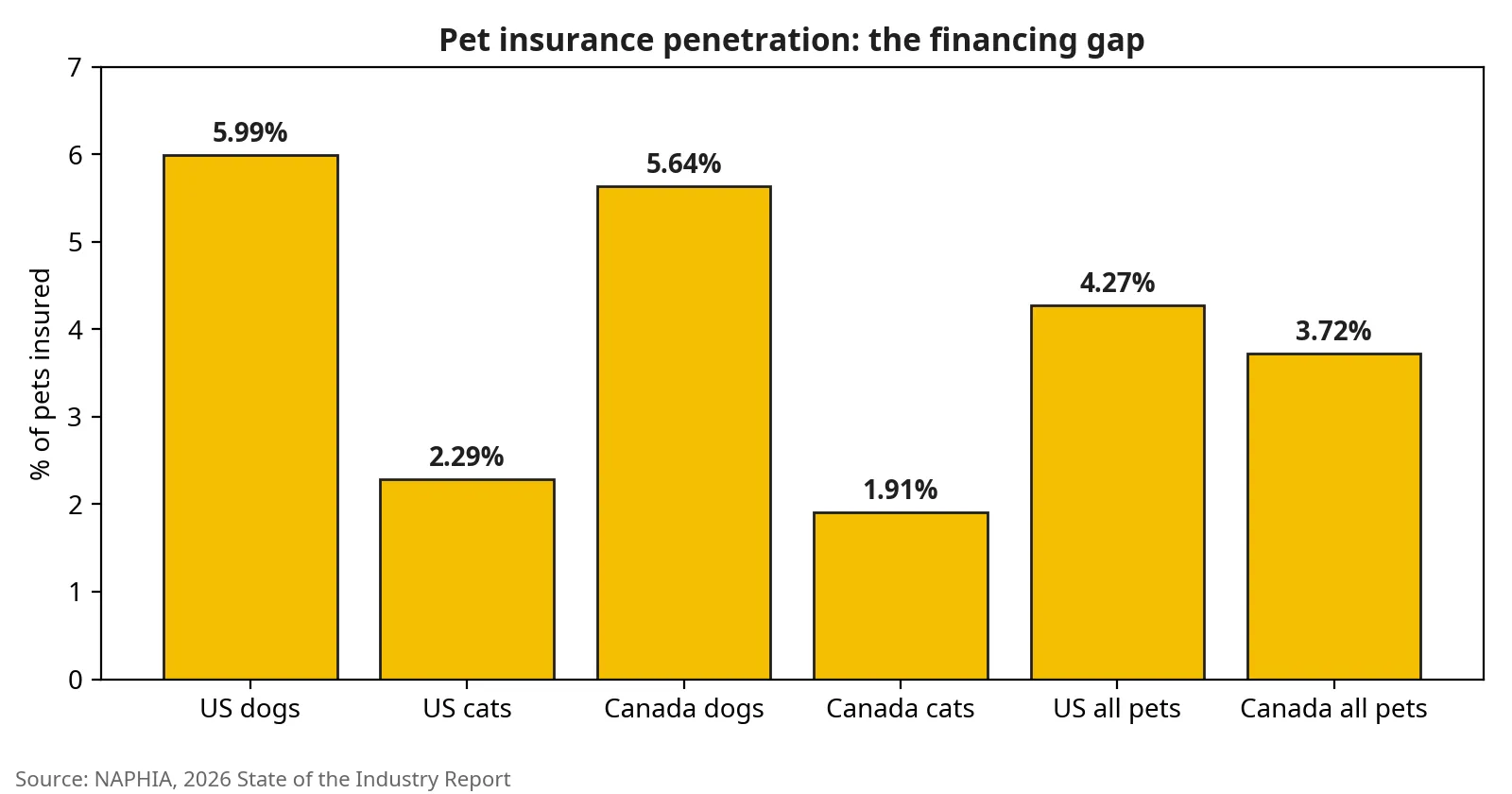
Stat callout: Only 4.27 percent of US pets and 3.72 percent of Canadian pets are insured, against 7.6 million insured pets in North America (NAPHIA).
What It Means For You
If you run a clinic or a clinic group
Decide which game you are in before a buyer decides for you. The front door game is now a scale game: Chewy can route members from a 21 million customer base into 47, soon roughly 60, clinics, and it underwrites clinics on ecosystem value, a 15 to 20 percent customer sales uplift, that a standalone practice cannot count. The referral game is consolidating too: AOSN's pitch to specialists is career development and residency infrastructure, not just a purchase price. If you are independent, your defensible assets are referring veterinarian relationships, a specialty niche with a waiting list, and a team that would not follow a logo change. Document them, and negotiate from them while multiple buyers are still assembling networks.
Watch your own mix the way the public companies report theirs. If visits are falling but revenue is rising on services and testing, you are riding the same intensity wave as IDEXX, and your risk is the payer ceiling, not demand. Build financing into the treatment plan: memberships, wellness plans, insurance conversations at puppy and kitten visits, and subscription refills, because the practices growing product revenue moved it to a subscription, up 14 percent nationally, instead of a counter sale, down 3.3 percent.
If you sell medicines, diagnostics, food, or supplies into clinics
Your channel is being rebuilt under you. Product sales at practices fell 3.3 percent in the AVMA tracked year while services rose 2.8 percent, and Zoetis's quarter shows what that does to even the strongest product portfolio when owners get price sensitive and generics arrive. The growth shelves inside the clinic are now the test menu, the software workflow, and the automated follow up. Ask where each product you sell appears in that workflow: ordered from the record the AI scribe just created, refilled by the platform the consolidator owns, or handed over a counter that is losing share. Only the first two positions are compounding.
Therapeutic food should take the same lesson. Hill's growing 5.6 percent in the third quarter on therapeutic diets shows the clinic recommended diet still works when it is part of a care plan, and a care plan written inside an ecosystem will recommend what that ecosystem stocks. Distribution into clinics is becoming distribution into platforms.
If you build software or AI for veterinary practices
Sell the land claim, not the time saving. CoVet's acquisition, on $5 million of expected first year revenue to its buyer, proves acquirers pay for position at the start of the clinical record, not for near term subscription income. Design for that diligence now: integrations with multiple practice management systems, data portability, and proof that your tool changes diagnostic utilization, refill capture, or recheck booking. Those are the metrics an ecosystem buyer can take to its board.
If you run a brand, a retailer, or a services business outside the clinic
Healthcare is becoming the loyalty program. A membership clinic relationship, an insured pet, and a subscription medication all do the same work as Autoship does for food: they convert an anxious, occasional buyer into a known, recurring one, with health data attached. If you sell supplements, dental care, calming, or senior products, your natural partners are no longer only retailers. They are clinic groups looking for at home care plans, insurers looking to cut claims with prevention, and platforms looking for attach products between visits.
If you are an investor or a corporate development lead
Underwrite the split, not the sector. "Pet healthcare" contains a diagnostics compounder growing at 10 percent with guidance raised, a diversified drug leader shrinking in its home companion market, a specialty consolidator assembling scarce specialists for undisclosed prices, and a pre-seed company measuring dog brains without touching them. The common thread is position in the visit: who owns the front door, who owns the referral, who owns the record, and who finances the bill. In diligence, ask for visits, tests per visit, services mix, product mix, and payer mix separately. A target growing revenue on falling visits is a price and intensity story, and its ceiling is the owner's wallet, which is why the financing layer, at 4.27 percent penetration and 20.8 percent premium growth, may be the most underbuilt position of the four.
What To Watch
Whether AOSN keeps buying, and whether specialists stay
AOSN says its model rests on specialist retention, residency development, and organic growth, at over 300 specialists and residents. Watch for the next portfolio additions, for whether the acquired brands keep their names and referring relationships, and for any disclosed hiring or residency expansion. Specialty consolidation works only if the specialists do.
Chewy's clinic count and the first real ecosystem numbers
Chewy is expected to reach roughly 60 clinics by the end of fiscal 2026 per analyst coverage, with Modern Animal contributing an estimated $70 million in fiscal 2026 revenue on the way to a steady state approaching $290 million. Its next results will show whether clinic customers deliver the promised 15 to 20 percent sales uplift and whether clinic EBITDA contribution arrives on the stated 2027 timeline. That print will price every retailer's clinic ambitions.
The diagnostics versus drugs split in the fourth quarter
IDEXX will detail its next point of care platform at an investor event in Orlando on January 18, 2027, and Zoetis narrowed revenue guidance while raising adjusted earnings guidance, a combination that says management expects companion pressure to persist. Watch fourth quarter diagnostics growth against companion drug growth, and US clinic visits: Zoetis reported visits down 3 percent year to date, with canine visits down 5 percent in the third quarter. If visits keep falling while testing keeps rising, the land grab accelerates.
Whether the payer layer closes the gap
NAPHIA's next read will show whether 7.6 million insured pets and $5.2 billion of US premium keep compounding, and whether cat penetration, at 2.29 percent in the US, finally moves. That number quietly caps the entire trend. Clinics, diagnostics, specialty networks, and AI can all take share of the visit. Only financing makes the visit itself bigger.
Sources
- GlobalPETS, How is the pet industry capitalizing on healthcare and vet growth?, November 4, 2026, reporting APPA and AVMA data: https://globalpetindustry.com/news/how-is-the-pet-industry-capitalizing-on-healthcare-and-vet-growth/
- Animal Outpatient Specialty Network, Animal Outpatient Specialty Network Acquires a Portfolio of Outpatient Specialty Practices, PR Newswire, November 3, 2026: https://www.morningstar.com/news/pr-newswire/20261103ny87526/animal-outpatient-specialty-network-acquires-a-portfolio-of-outpatient-specialty-practices
- Chewy, Chewy to Acquire Modern Animal Accelerating Evolution to a Fully Integrated Healthcare Ecosystem, April 8, 2026: https://investor.chewy.com/news-and-events/news/news-details/2026/Chewy-to-Acquire-Modern-Animal-Accelerating-Evolution-to-a-Fully-Integrated-Healthcare-Ecosystem/default.aspx
- Zacks, Chewy's Modern Animal Acquisition Strengthens Pet Healthcare Platform, June 22, 2026, and CHWY's Push Into Veterinary Services Broadens Its Addressable Market, June 15, 2026: https://www.zacks.com/stock/news/2940881/chewys-modern-animal-acquisition-strengthens-pet-healthcare-platform
- IDEXX Laboratories, IDEXX Laboratories Acquires CoVetAI to Advance Veterinary Workflow Intelligence, September 16, 2026: https://ir.idexx.com/news-events/press-releases/detail/417/idexx-laboratories-acquires-covetai-to-advance-veterinary-workflow-intelligence
- IDEXX Laboratories, third quarter 2026 results as reported November 2, 2026, via The Motley Fool earnings call transcript: https://www.fool.com/earnings/call-transcripts/2026/11/02/idexx-idxx-q3-2026-earnings-call-transcript/
- Zoetis, Zoetis Announces Third Quarter 2026 Results, Business Wire, November 4, 2026: https://www.businesswire.com/news/home/20261104076504/en/Zoetis-Announces-Third-Quarter-2026-Results-Highlights-Progress-Advancing-Innovation-Across-Diversified-Portfolio-and-Narrows-Full-Year-2026-Revenue-Guidance-Raises-Full-Year-2026-Adjusted-EPS-Guidance
- APPA, 2026 State of the Industry, total and category expenditures as reported by Pet Food Processing: https://www.petfoodprocessing.net/articles/21022-selective-growth-state-of-the-pet-food-treat-industry-in-2026
- NAPHIA, North American Pet Insurance Adoption Continues to Grow as 7.6 Million Pet Parents Seek Peace of Mind, PR Newswire, June 24, 2026, and NAPHIA 2026 State of the Industry Report highlights: https://www.prnewswire.com/news-releases/north-american-pet-insurance-adoption-continues-to-grow-as-7-6-million-pet-parents-seek-peace-of-mind-302809455.html
- Dealroom News, Janus Labs raises $1.8M pre-seed for contactless neural AI reading pets' brains, November 3, 2026: https://dealroom.co/news/169182-janus-labs-raises-1-8m-pre-seed-for-contactless-neural-ai-reading-pets-b/
- NewMarketPitch, Top PetTech Startups by Fundraising (2026), updated November 3, 2026, Petvisor and Otto funding totals: https://newmarketpitch.com/blogs/news/pet-tech-top-startups-fundraising