The Marketplace Squeeze: Amazon Now Sells $1.4 Billion of Pet Products a Month in the US
Pet retail is reorganizing around platforms that own the search bar, the delivery van and, increasingly, the inventory itself, and new data on Amazon's first-party business shows how far the shift has gone.
By Good Company Editorial Desk
The Short Version
- The trend: pet products are becoming a platform business. Packaged Facts puts e-commerce at 41 percent of US retail pet product sales in 2026, up from 24 percent in 2019, and platforms are splitting into two models, first-party retail where the platform owns the stock, and third-party marketplaces where brands rent the shelf.
- The biggest number: Amazon's US pet sales reached roughly $1.4 billion a month, up 32.6 percent in 12 months, with more than 54 million units sold, according to SmartScout data shared with GlobalPETS on October 29, 2026.
- The biggest structural fact: first-party vendors take 23.4 percent of Amazon's US pet revenue, $322 million a month, reaching 78.6 percent in dog food, 89 percent in cat food and 84.5 percent in treats, while third-party brands grow faster, at 108 percent against 34 percent.
- The defense that works: Chewy's Autoship did $2.82 billion in its second quarter, 84.6 percent of net sales, because a subscription the customer set up is the one shelf position a marketplace cannot easily take away.
- The reader takeaway: your channel plan is now a portfolio decision. Heavy food behaves like wholesale, light accessories like a global auction, and discovery is moving to TikTok Shop, so price each model separately or the platform will price it for you.
The News
The data that frames the whole trend
On October 29, 2026, GlobalPETS published SmartScout data on Amazon's US pet category, covering the 12 months from August 11, 2025 to August 11, 2026. First-party vendors, brands that sell directly to Amazon, which then owns the inventory, sets the price and runs the logistics, account for 23.4 percent of the platform's monthly pet revenue. That is $322 million a month in first-party revenue alone. Total US pet sales on Amazon, first and third party combined, grew 32.6 percent in 12 months to roughly $1.4 billion a month, with more than 54 million units sold, making pet the 10th most profitable of the 29 categories SmartScout measured.
Read that against the whole industry. The American Pet Products Association (APPA) reported US pet industry expenditures of $158 billion in 2025, up 3.7 percent, and projects $165 billion for 2026, growth of about 4.4 percent, of which roughly 2 points is inflation. One platform's US pet storefront, at roughly $1.4 billion a month, annualizes to a business on the order of a tenth of the entire US pet industry, growing at 32.6 percent while the industry grows at about 4 percent. That gap, not any single launch, is the trend.
The pet industry continues to be a healthy, evolving market. Growth remains steady, ownership is expanding across multiple generations, and consumers are becoming more intentional with how they spend, prioritizing essential care while still investing in their pets' wellbeing.
Pete Scott, President and CEO of APPA, in the APPA 2026 State of the Industry release.
Food is wholesale, accessories are an auction
The split by category is where the story sharpens. SmartScout CEO Scott Needham told GlobalPETS that some categories such as dog food are "cost-prohibitive" for third-party sales, because heavy bags punish any seller who cannot match Amazon's negotiated shipping rates. In the data as GlobalPETS reported it, the first-party share of Amazon revenue reaches 78.6 percent in dog food, 89 percent in cat food, 84.5 percent in treats and 100 percent in pet insect supplies. Third-party sellers dominate horse, bird and amphibian food and health supplies, the lighter corners where a small seller's economics still work.
The different logistic price points offered for oversized Amazon vendors really push that category to be 1P.
Scott Needham, CEO of SmartScout, in comments reported by GlobalPETS.
Needham also gave GlobalPETS the growth split, and it cuts the other way: first-party pet brands are growing at 34 percent a year, third-party pet brands at 108 percent. The mature, heavy, replenishment categories consolidate into Amazon's own retail operation. The energy, the new brands and the long tail sit in the third-party marketplace, where smaller players start. Both halves are growing into different jobs, and a brand can easily be in the wrong half for its product.
The competitive map is just as split. Needham told GlobalPETS that beauty, grocery, health and wellness and parts of pet have so far proved more resilient to Chinese sellers than electronics, home and kitchen and apparel. In pet, the exposed flank is accessories: Chinese sellers represent 70.3 percent of revenue in dog apparel and accessories, 60.6 percent of crates, houses and enclosures, and 52 percent of doors, gates and ramps, according to SmartScout via GlobalPETS. In cat subcategories the shares are higher: 80.3 percent of apparel, 67.3 percent of beds and furniture, and 66.1 percent of collars, harnesses and leashes. Food, treats and health, where regulation, freshness and trust matter most, have held. Collars, beds and costumes are already a global auction.
Chewy answers with the subscription, not the shelf
Chewy is the largest pet specialist built for this world, and its second quarter of fiscal 2026 shows the defense in numbers. Net sales rose 7.3 percent to $3.33 billion for the 13 weeks ended August 2, 2026. Active customers grew 3.8 percent to 21.7 million, and net sales per active customer rose to $602. Autoship customer sales climbed 9.3 percent to $2.82 billion, 84.6 percent of total net sales. Chewy raised its fiscal 2026 outlook to $13.46 billion to $13.57 billion, and management told analysts it expects AI initiatives to save low tens of millions in fiscal 2026 and about $50 million annualized in fiscal 2027, according to Zacks coverage of the earnings call.
That mix is the point. A marketplace can undercut a bag of food this week. It cannot easily undercut a replenishment schedule set up two years ago, attached to a pet profile and a trusted service relationship. Brands still use Chewy as a launch shelf too: on October 29, 2026, Standard Process announced Spirited Paw, its supplement brand, is now available at Chewy.
Every pet retailer is becoming a marketplace
The model is spreading beyond Amazon. On October 26, 2026, GlobalPETS reported that zooplus, the European online pet retailer, has launched a marketplace in Spain, adding 10,000 products, its third marketplace country after Germany and France. Since launching in Germany in July 2026, zooplus has tripled the products available to more than 30,000, and its seller base has more than doubled to over 100 partners. Fresh and frozen pet food now accounts for more than 10 percent of total sales on the German marketplace, a category zooplus can offer without building fresh and frozen logistics of its own, according to the company. Zooplus serves 12 million customers across 30 countries and plans more marketplace countries in 2027. Its logic is the same logic running Amazon's US category, so read it as a preview of what North American specialists will be pressed to copy.
Marketplace is one way to expand our assortment more quickly in the categories that our customers care most about.
Lionel Desclée, CEO of zooplus, in comments reported by GlobalPETS.
The discovery end is moving too. US TikTok Shop sales reached $15.82 billion in 2025, up 108 percent year over year, according to eMarketer figures cited by Netpeak, and Pet Supplies is one of its fastest growing categories heading into 2026, according to YipitData cited in the same analysis. The blended median order value sits near $32 and products under $50 perform best, exactly the accessory, treat and toy territory where Amazon's third-party sellers already fight Chinese competitors. TikTok Shop's referral fee runs about 6 percent per order, before promotion fees and creator commissions sellers set themselves, commonly 8 to 22 percent. Discovery is no longer a search page. It is a creator holding your product, and the commission stack is part of your price whether you planned it or not.
The companies in this trend
Platforms and retailers:
- Amazon (United States and Canada): roughly $1.4 billion a month in US pet sales, up 32.6 percent, first-party vendors at 23.4 percent of US pet revenue, according to SmartScout via GlobalPETS. Canada is its largest first-party pet market outside the US, at $64 million a month, 19.6 percent of platform pet sales there.
- Chewy (United States): $3.33 billion in second quarter net sales, up 7.3 percent, 21.7 million active customers, Autoship at 84.6 percent of sales, and a raised fiscal 2026 outlook of $13.46 billion to $13.57 billion.
- Walmart (United States): named among the leading US pet product retailers by Packaged Facts, and holder of about 28 percent mental market share in Morning Consult research, with about 68 percent brand association on price searches.
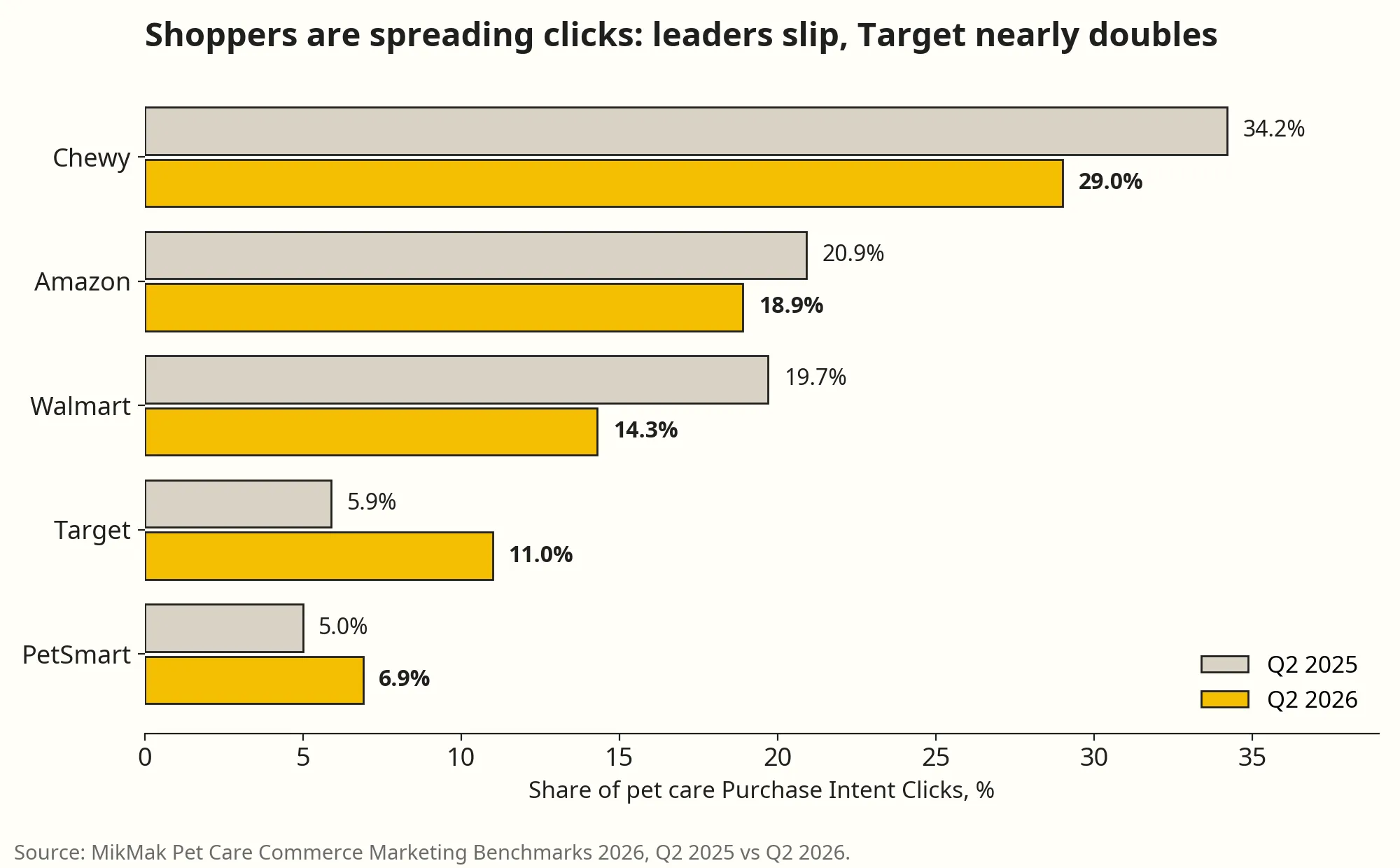
- Target (United States): the riser in MikMak's benchmarks, its share of Purchase Intent Clicks nearly doubling from 5.9 percent to 11.0 percent in Q2 2026.
- TikTok Shop (United States): $15.82 billion in US sales in 2025, up 108 percent, with Pet Supplies among its fastest growing categories, according to eMarketer and YipitData figures cited by Netpeak.
- Petco (United States): second quarter net sales of $1.49 billion, up 0.05 percent, comparable sales up 0.6 percent, adjusted EBITDA of $122 million, and 1,377 stores.
- PetSmart (United States and Canada): intent share rose from 5.0 percent to 6.9 percent in MikMak's Q2 comparison, a reminder that store backed specialists can still gain digital intent.
- Tractor Supply (United States): pet business up 5 percent in the third quarter including new stores, Allivet and VIP Petcare, with companion comparable sales down about 2 percent, improving from down 4 percent in Q1, according to GlobalPETS.
- Pet Supplies Plus (United States): more than 725 locations, more than 11,000 products from 400 brands, described by the company as the country's largest pet retail franchise, according to GlobalPETS.
- Pet Valu (Canada): its store family, including Bosley's, Paulmac's Pets, Tisol and Total Pet, holds an exclusive on K9 Natural's Baked & Coated line through May 2027, according to PetfoodIndustry.
- zooplus (Europe, as the model to watch): marketplaces in three countries, more than 30,000 products in Germany, over 100 sellers, fresh and frozen above 10 percent of German marketplace sales, more countries planned for 2027.
Brands, suppliers and services navigating the platforms:
- Nestlé Purina: real internal growth accelerated to 4.3 percent in Q3, with pricing turning positive, according to GlobalPETS reporting of Nestlé results.
- Blue Buffalo (General Mills): pledged a $200,000 donation match to Morris Animal Foundation through December 31, 2026, extending a partnership that has contributed more than $9 million over nearly 20 years, according to PetfoodIndustry. Trust building is part of how a large brand defends a premium on a screen of cheaper options.
- Spirited Paw (Standard Process, Wisconsin): launched on Chewy on October 29, 2026, using the specialist platform as its national access move.
- K9 Natural (Natural Pet Food Group): launched Baked & Coated dog food in Canada exclusively through Pet Valu, with three recipes the company says carry 40 percent protein and 90 percent digestibility. Exclusivity is the opposite bet to marketplace everywhere.
- H&H Group: pet supplements revenue up 3.5 percent in the first nine months of 2026, North America growth offsetting a China decline, according to GlobalPETS.
- Symrise: pet food growth in the low single digits in Q3 on positive volumes, while its Taste, Nutrition & Health segment generated €790 million in Q3 sales, according to GlobalPETS.
- Scoular and Giorgi Mushroom Co.: partnering to bring proprietary mushroom blends, using mushroom stems, to pet food, according to PetfoodIndustry coverage of Scoular's fiscal 2026 sustainability reporting. Ingredient differentiation is one claim a listing cannot commoditize overnight.
- SmartScout: the analytics firm behind the Amazon data in this piece. That a data vendor's category map is now trade press news shows how much strategy is set by platform data most brands do not own.
Why It Matters
Logistics, not marketing, decides who sells food online
The first-party percentages in dog and cat food are not a branding outcome. They are a freight outcome. A 30 pound bag has a shipping cost that barely moves with the brand on the bag, so the seller with the cheapest negotiated logistics wins the transaction, and on Amazon that seller is increasingly Amazon itself, buying from first-party vendors at wholesale. Needham's "cost-prohibitive" comment is a category rule: the heavier and more routine the product, the more online food retail behaves like wholesale distribution with a search bar on top. Brands in that world negotiate like suppliers, on terms, freight and retail media, not like advertisers buying attention.
Third-party economics run the other way. Light, compact, high margin products can absorb fees and shipping and still leave margin, which is why third-party brands are growing at 108 percent and the long tail explodes there. It is also why that territory is exposed globally: what makes a collar cheap to ship from Ohio makes it cheap to ship from Shenzhen. The Chinese seller shares in apparel and collars are what an open marketplace does to any category where differentiation fits in a photo.
The shelf is infinite, so attention is the scarce asset
On a physical shelf, a category has room for a handful of brands. On Amazon, basic dog collars are only the 34th largest subcategory by revenue and still host more than 2,000 brands, according to SmartScout via GlobalPETS. Chew toys host more than 1,840 brands on $10.3 million a month. Dog beds host 1,719, and treat cookies and snacks, the top selling subcategory, host 1,383. Even funeral and memorial items support about 1,800 brands on almost $2 million a month. An infinite shelf does not remove competition. It moves it from getting listed to getting chosen, a contest of reviews, search rank, retail media and price, renewed every day.
The subcategories with the fewest players matter too. SmartScout lists reptile and amphibian supplies, filters and pumps, dog kennels and lick mats, and frozen and air dried cat food among the least crowded. Frozen and air dried cat food pairs low competition with the growth in this data, where cat subcategories grew 48 percent on average, ahead of terrarium at 51 percent and dog at 16 percent. White space shows in the data before it shows in a planogram, and it does not stay white for long.
Specialists are squeezed from both ends, and the exits are services, exclusivity and subscriptions
Petco's quarter is the squeeze in one set of results: $1.49 billion in sales, up 0.05 percent, profitability improving faster than sales, adjusted EBITDA of $122 million and gross margin of 39.7 percent, helped by a $6.8 million net tariff refund benefit, according to its results reporting. A store chain can still make money here, but growth must come from somewhere other than the bag of food the platforms deliver. Petco's levers are loyalty, with its relaunched Perks program driving higher redemption in the quarter, and services and health, which a parcel network cannot ship.
Tractor Supply shows the rural version. Its total pet business grew 5 percent in Q3 including new stores, Allivet and VIP Petcare, while companion comparable sales were still down about 2 percent, improving from down 4 percent in Q1. The growth assets are services, clinics and new boxes, not price competition on identical SKUs. K9 Natural's Canadian launch shows the brand side of the exit: an exclusive with Pet Valu through May 2027 trades platform reach for one committed partner and a protected price. Spirited Paw's Chewy launch is the middle path, platform reach where supplements sit next to pharmacy and Autoship rather than the cheapest collar on the internet.
Stat callout: Amazon's US pet sales total roughly $1.4 billion a month, up 32.6 percent in 12 months, with more than 54 million units sold (SmartScout via GlobalPETS).
Price pressure has paused in the US and risen in Canada, which changes the platform pitch
GlobalPETS' October 30, 2026 inflation snapshot, drawing on the US Bureau of Labor Statistics and Statistics Canada, reported US pet food and treats prices unchanged in September, supplies and accessories down 0.8 percent and veterinary services up 0.3 percent. Canada moved the other way, pet food and supplies up 2.8 percent after a 0.5 percent decline in August. For US brands, a flat price month removes the easiest excuse for discounting and puts the argument back on convenience. For Canada, a 2.8 percent jump makes value formats and platform offers more dangerous, and specialty service a harder sell.
The Numbers
The market the platforms are dividing
- $158 billion: total US pet industry expenditures in 2025, up 3.7 percent, according to APPA
- $165 billion: APPA's projected US expenditures for 2026, up about 4.4 percent, with roughly 2 points attributed to inflation
- $68.3 billion: US pet food and treats spending in 2025, 43 percent of the total, according to APPA figures reported in industry coverage
- 41 percent: e-commerce share of US retail pet product sales in 2026, up from 24 percent in 2019, according to Packaged Facts
- 39 percent: share of US pet food sales occurring online, according to Packaged Facts in late 2025, reported by PetfoodIndustry, with omnichannel shoppers at 64.2 percent of pet food dollars, according to NielsenIQ
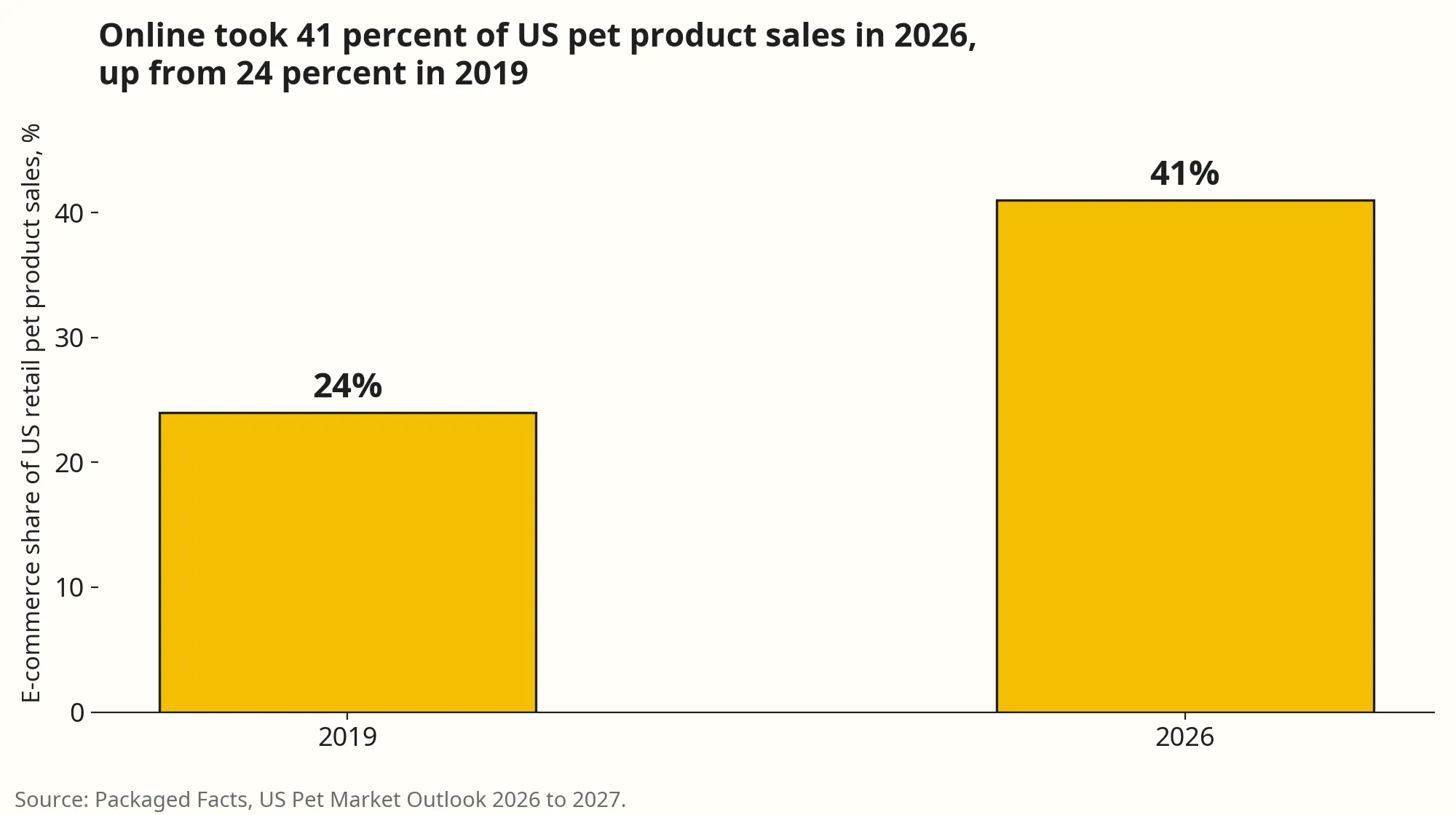
Stat callout: E-commerce took 41 percent of US retail pet product sales in 2026, up from 24 percent in 2019 (Packaged Facts).
Amazon, by the SmartScout data
- Roughly $1.4 billion: total monthly US pet sales on Amazon, up 32.6 percent in 12 months, with more than 54 million units sold (SmartScout via GlobalPETS)
- $322 million: monthly first-party pet revenue on Amazon US, 23.4 percent of category revenue on the platform
- 78.6 percent, 89 percent and 84.5 percent: first-party shares of Amazon revenue in dog food, cat food and treats, with 100 percent in pet insect supplies (SmartScout via GlobalPETS)
- 34 percent vs 108 percent: annual growth of first-party pet brands vs third-party pet brands (SmartScout CEO Scott Needham, via GlobalPETS)
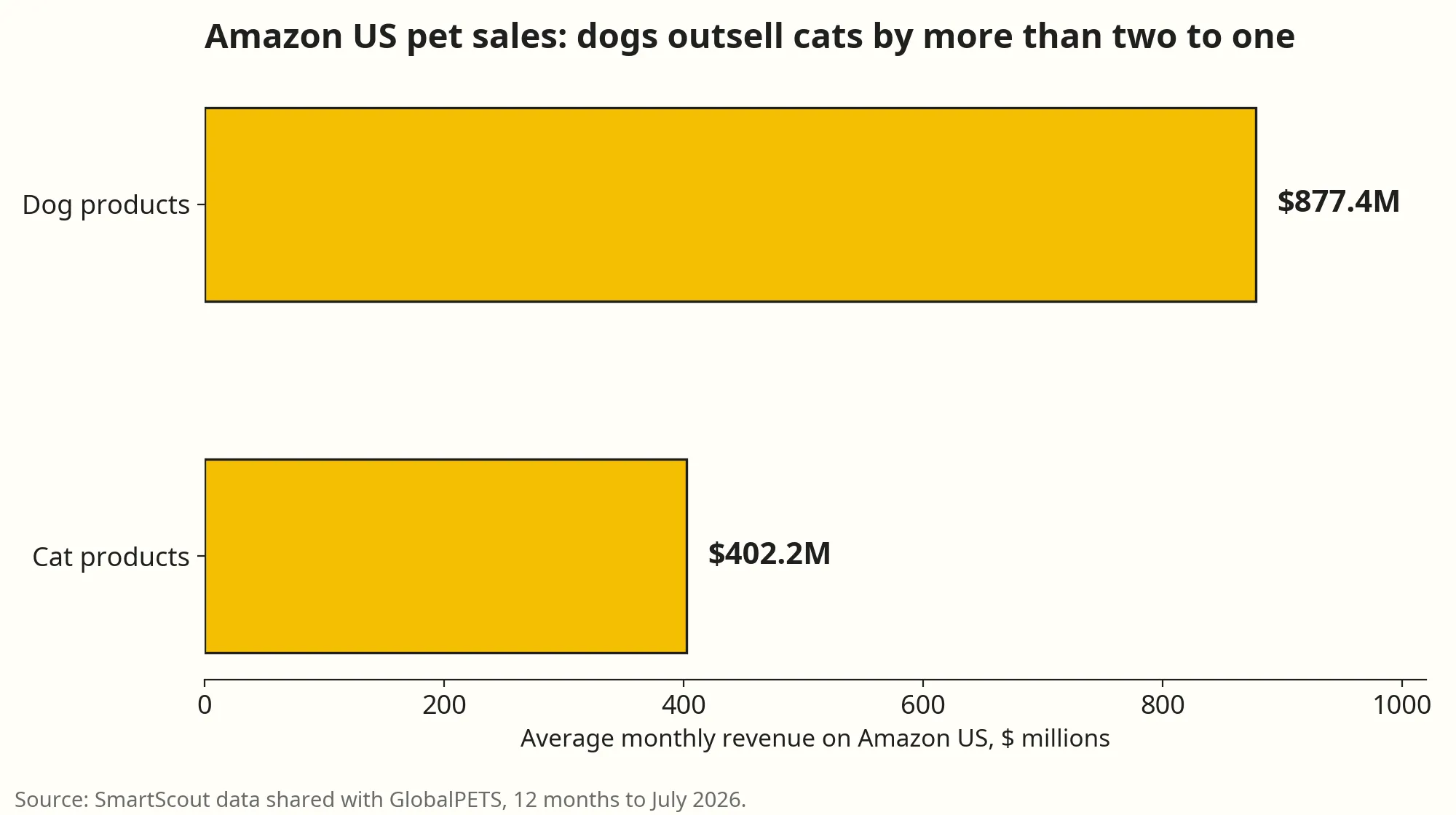
- $877.4 million: monthly revenue from dog products on Amazon US in the 12 months to July 2026, against $402.2 million for cat products and about one twentieth of the dog figure for fish and aquatic supplies
- 51 percent, 48 percent and 16 percent: average subcategory growth for terrarium, cat and dog respectively
- More than 2,000 brands: sellers in basic dog collars alone, with more than 1,840 in chew toys, 1,719 in dog beds and 1,383 in treat cookies and snacks
- 70.3 percent, 60.6 percent and 52 percent: Chinese sellers' shares in dog apparel, crates and enclosures, and doors, gates and ramps, with 80.3 percent in cat apparel
- $64 million: average monthly first-party pet revenue on Amazon in Canada, 19.6 percent of pet sales on the platform there, the largest first-party market outside the US, ahead of the UK at $41.3 million and Germany at $26.5 million
Stat callout: First-party vendors take 89 percent of Amazon's cat food revenue and 84.5 percent of treats revenue, while third-party brands grow at 108 percent (SmartScout via GlobalPETS).
The other platforms, in their own reported figures
- Chewy: $3.33 billion net sales in Q2 fiscal 2026, up 7.3 percent; Autoship $2.82 billion, up 9.3 percent, at 84.6 percent of sales; 21.7 million active customers; $602 sales per active customer; guidance raised to $13.46 billion to $13.57 billion
- Petco: $1.49 billion net sales in Q2 2026, up 0.05 percent; comparable sales up 0.6 percent; adjusted EBITDA $122 million; gross margin 39.7 percent; 1,377 stores
- Tractor Supply: total pet business up 5 percent in Q3, companion comparable sales down about 2 percent, improving from down 4 percent in Q1
- TikTok Shop: $15.82 billion in US sales in 2025, up 108 percent (eMarketer via Netpeak), median order value near $32, sub $50 products performing best
- zooplus marketplace: more than 30,000 products in Germany since July 2026, over 100 sellers, fresh and frozen above 10 percent of German marketplace sales
Intent is spreading out
MikMak's 2026 benchmarks compare where shoppers click with purchase intent. Chewy stayed first but fell from 34.2 to 29.0 percent between Q2 2025 and Q2 2026. Amazon fell from 20.9 to 18.9 percent and Walmart from 19.7 to 14.3 percent, while Target nearly doubled from 5.9 to 11.0 percent and PetSmart rose from 5.0 to 6.9 percent. Paid search remained the leading source at 71.0 percent. The leaders are not losing the category. They are losing exclusivity, as shoppers spread the same basket across more shelves.
Morning Consult points the same way from memory: Walmart holds about 28 percent mental market share, nearly double PetSmart at about 15 percent, and leads on price searches at about 68 percent and regular trips at about 70 percent, while Chewy leads digital associations, about 50 percent for online ordering and about 47 percent for auto delivery, and Amazon scores about 59 percent on online ordering against overall mental share of about 10 percent. Owners think of the generalist first, the specialist for depth, and the platform for speed. Brands have to be findable in all three memories at once.
What It Means For You
If you sell food or treats
Price your Amazon business as two businesses. In first-party, you are a wholesale supplier to the largest pet retailer in the country: negotiate freight, terms and retail media as supplier economics, and watch the 89 percent cat food figure before assuming a third-party listing is the strategy. In third-party, you are paying rent for discovery: fees, shipping on heavy product and returns can erase the margin the list price promises, which is why Needham calls dog food cost-prohibitive for many third-party sellers. Run the fully loaded cost per pound delivered before you choose, not after the first freight bill.
Defend the replenishment, not the transaction. Chewy's 84.6 percent Autoship mix is the scoreboard for a defended repeat purchase. If your repeat buyers live on open listings, any competitor with a coupon can intercept the next order. Subscriptions on your own site and Autoship presence are not loyalty garnish. They are the only shelf position that compounds.
If you sell accessories, beds, toys or apparel
Assume global competition from day one: 70.3 percent of dog apparel revenue and 80.3 percent of cat apparel revenue on Amazon US comes from Chinese sellers, in categories with 1,700 to 2,000 brands each. Competing on look and price is a losing brief. Competing on fit data, safety testing, materials proof, durability guarantees and review volume is a defensible one. Take TikTok Shop seriously as your discovery shelf, but budget the real stack, about 6 percent referral plus 8 to 22 percent creator commission plus returns, before calling it cheaper than Amazon.
Chase the quiet subcategories. The least crowded corners SmartScout names, frozen and air dried cat food among them, sit next to the fastest growth in the data, cat at 48 percent. Review the empty shelves quarterly, with the discipline you would give a retail reset calendar.
If you run specialty retail or a marketplace of your own
Copy the zooplus sequence, not just the headline. Start where logistics block you, as zooplus did with fresh and frozen at above 10 percent of German marketplace sales, keep direct brand partnerships at the core, and use the marketplace to test small brands before committing capital. In the US and Canada, the specialist version is services plus exclusivity: Petco's loyalty and services, Tractor Supply's clinics through Allivet and VIP Petcare, and Pet Valu's K9 Natural exclusive all sell what a parcel cannot. Measure your store on occasions platforms cannot serve: same day need, advice, services, exclusive product.
Watch Target. A near doubling of intent share to 11.0 percent while Chewy, Amazon and Walmart all slipped says mass retail with decent digital execution is taking intent from everyone. If your media plan treats Target and Walmart as one line called mass, split it. They are moving in opposite directions.
If you are an investor or a corporate development lead
Underwrite the channel mix, not the brand story. Ask what share of revenue is first-party wholesale, third-party marketplace, specialist platform, direct subscription and store retail, and what each earns after freight, fees, retail media and creator commissions. A brand growing at third-party speed, 108 percent in the SmartScout cohort, is a different asset from a first-party food supplier growing at 34 percent inside Amazon's retail machine, and both differ from a subscription base doing $602 per active customer.
What To Watch
Whether first-party keeps taking food
The next SmartScout style read will show whether first-party shares in cat food, dog food and treats keep climbing from 89, 78.6 and 84.5 percent. If they do, more large food brands will quietly become wholesale suppliers first and marketers second, and third-party food will retreat further into the light corners it already dominates. Watch whether Amazon extends first-party economics in Canada, where it is already $64 million a month.
Chewy's holiday quarter and the AI savings claim
Chewy guided Q3 net sales of $3.323 billion to $3.358 billion and told analysts to expect AI savings of low tens of millions in fiscal 2026 and about $50 million annualized in fiscal 2027. Its holiday quarter will test the Autoship moat, 84.6 percent of sales and growing at 9.3 percent, and whether a specialist can widen a margin the platforms keep compressing. Petco's next results will show whether flat sales with improving profit is a strategy or a stall.
The marketplace copycats and the discovery shift
Watch for North American specialists announcing zooplus style marketplaces or partner fulfilled fresh and frozen offers, and for zooplus to name its 2027 countries. Watch TikTok Shop pet through the holidays: if a sub $50 product can be discovered, demonstrated and delivered in one app at a 6 percent referral fee, the accessory categories exposed on Amazon get a second auction to defend. And watch Canadian pricing after September's 2.8 percent jump: sustained increases push owners toward platforms and value formats.
Sources
- GlobalPETS, Amazon captures nearly a quarter of US pet sales through first-party vendors, October 29, 2026, reporting SmartScout data: https://globalpetindustry.com/news/amazon-captures-nearly-a-quarter-of-us-pet-sales-through-first-party-vendors/
- GlobalPETS, zooplus expands marketplace offer in Spain, with more markets planned for 2027, October 26, 2026: https://globalpetindustry.com/news/zooplus-expands-marketplace-offer-in-spain-with-more-markets-planned-for-2027/
- GlobalPETS, Inflation snapshot: Pet product inflation cools in most major economies, October 30, 2026: https://globalpetindustry.com/news/inflation-snapshot-pet-product-inflation-cools-in-most-major-economies/
- GlobalPETS, H&H pet revenue declines in China but grows in North America, October 29, 2026, and Symrise: pet food growth remains in the low single digits in Q3, October 28, 2026, via GlobalPETS news archive: http://globalpetindustry.com/topic/news/
- APPA, US Pet Industry Reaches $158 Billion in 2025, Poised for Continued Growth in 2026, March 26, 2026: https://americanpetproducts.org/news/u.s.-pet-industry-reaches-158-billion-in-2025-poised-for-continued-growth-in-2026
- PetfoodIndustry, Online pet food shopping in 2026: Snapshots and nuances, reporting Packaged Facts and NielsenIQ figures: https://www.petfoodindustry.com/blogs-columns/adventures-in-pet-food/blog/15820594/online-pet-food-shopping-in-2026-snapshots-and-nuances
- Packaged Facts, US Pet Market Outlook 2026 to 2027, e-commerce share figures via ECRM presentation: https://asgard.marketgate.com/MarketingFiles/Media/20260615/Packaged_Facts_ECRM_2026.pdf
- Zacks, Chewy Q2 earnings coverage, September 2026, via search results: https://WWW.ZACKS.COM/stock/news/3003893/chewy-chwy-down-103-since-last-earnings-report-can-it-rebound
- Petco, Reports Second Quarter 2026 Results, PR Newswire, September 2, 2026: https://pr.chestercounty.com/article/Petco-Reports-Second-Quarter-2026-Results/6a9882475c73a7935efd23c7
- Standard Process, Spirited Paw Pet Supplements Now Available at Chewy, GlobeNewswire, October 29, 2026: https://www.wcia.com/business/press-releases/globenewswire/9855557/spirited-paw-pet-supplements-now-available-at-chewy/
- PetfoodIndustry, K9 Natural launches high-protein kibble in Canada, October 27, 2026: https://www.petfoodindustry.com/news-newsletters/pet-food-news/news/15975523/k9-natural-launches-highprotein-kibble-in-canada
- PetfoodIndustry, Blue Buffalo pledges $200,000 pet cancer research match, October 29, 2026: https://www.petfoodindustry.com/news-newsletters/pet-food-news/news/16050562/blue-buffalo-pledges-200000-pet-cancer-research-match
- PetfoodIndustry, Scoular, Giorgi bring mushroom ingredients to pet food, October 27, 2026: https://www.petfoodindustry.com/nutrition/pet-food-ingredients/news/15975613/scoular-giorgi-bring-mushroom-ingredients-to-pet-food
- MikMak, Pet Care Commerce Marketing Benchmarks 2026: https://www.mikmak.com/commerce-marketing-benchmarks/pet-care
- Morning Consult, The Pet Retail Category is Dominated By a Non-Pet Brand: https://morningconsult.com/articles/the-pet-retail-category-is-dominated-by-a-non-pet-brand
- Netpeak, How Concentrated Is the US Pet E-Commerce Market?: https://netpeak.us/blog/how-concentrated-is-the-us-pet-e-commerce-market/
- Netpeak, Should US Pet Brands Be on TikTok Shop? What Europe's 2026 Numbers Reveal, citing eMarketer and YipitData: https://netpeak.us/blog/should-us-pet-brands-be-on-tiktok-shop-what-europe-s-2026-numbers-reveal/
Charts: 2026-10-30-marketplace-chart-amazon.png, 2026-10-30-marketplace-chart-ecommerce.png, 2026-10-30-marketplace-chart-intent.png, built from sourced figures cited in The Numbers, in Good Company gold and charcoal.